Every PM software vendor has the same answer when you ask about their API: "Oh yeah, we have one, and it's great!"
Cool. Can it write data, or only read it? Can I hand an AI agent a limited key and shut it off when I'm done? Or is the thing I actually need sitting behind the next pricing tier?
That's where the answers stop sounding the same.
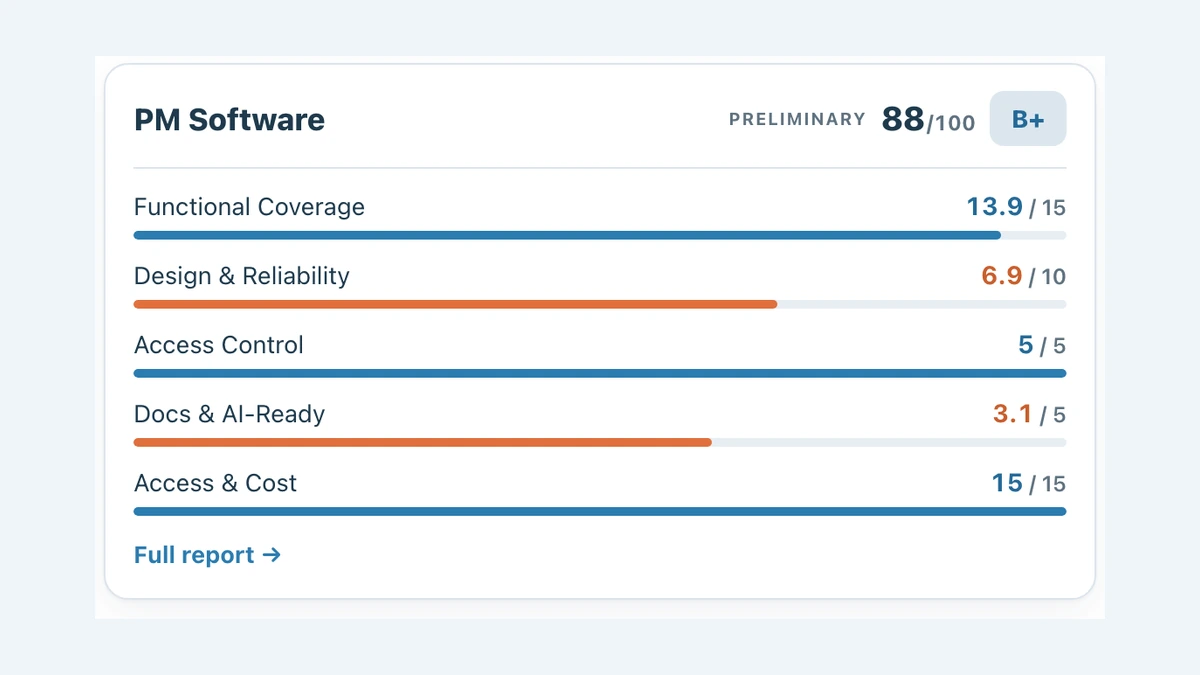
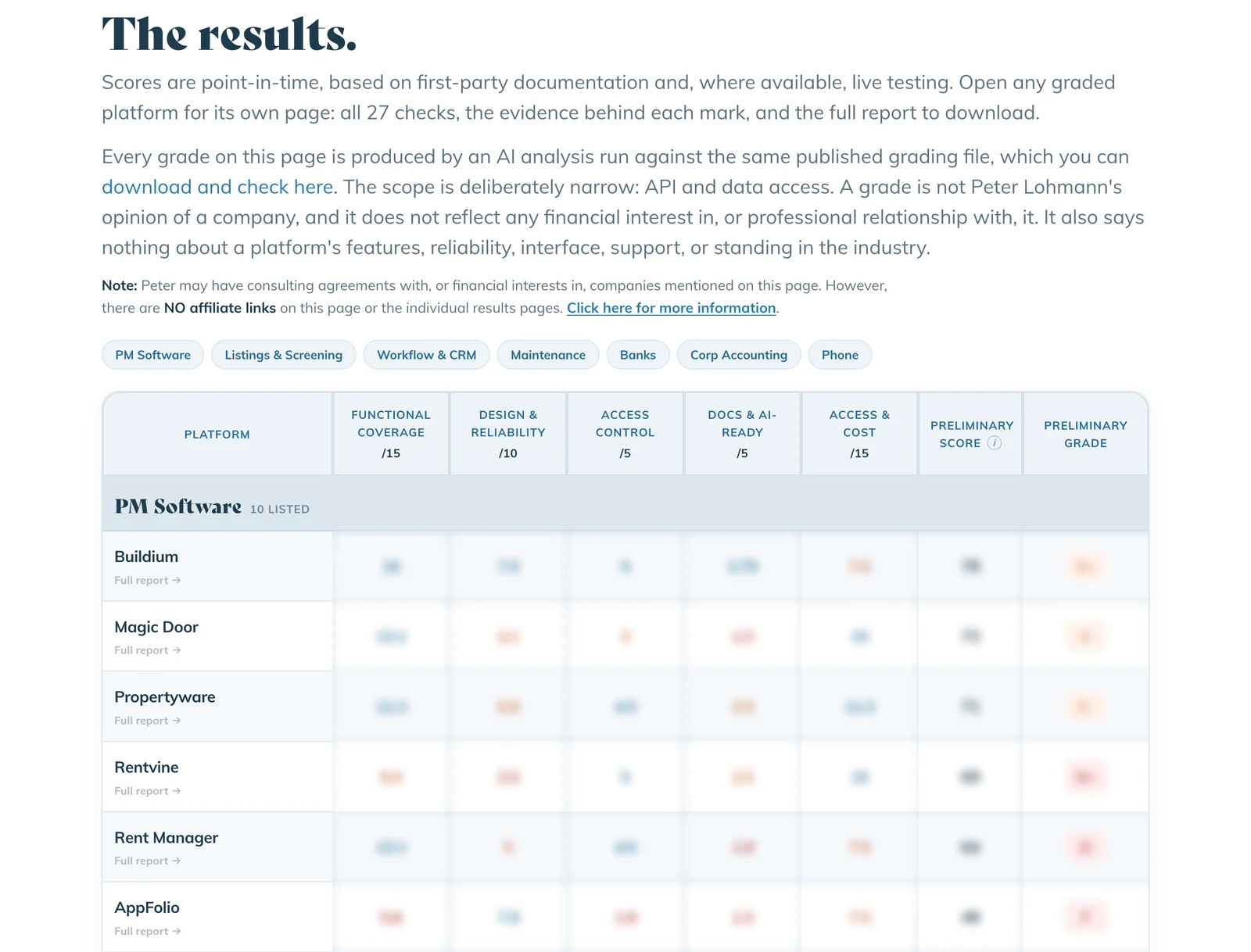
So I built a free, public scorecard that grades the APIs behind the software we all run our businesses on. It's called the PM API Report Card, and the preliminary scores are live right now.
(Short on time? Here are the scores and here's the grading guide. The rest of this post is the backstory, how the grading actually works, and what I'm hoping happens over the next 60 days.)
If you'd rather watch than read, here's the quick video walkthrough:
Your PM software is a database with a nice paint job
Strip away the dashboards and every PM platform we use is a glorified relational database. Every owner, tenant, and vendor record your company has lives in there.
For years, that was a perfectly fair deal. We logged in, pointed, clicked, and got the work done. Nobody spent much time thinking about the back end.
Then Claude and ChatGPT showed up and reset everyone's expectations about what our data is worth and what it can do. AI agents and vibe-coded software can already handle a real chunk of day-to-day PM work, and that's going to be true for most of us in an extraordinarily short amount of time.
All of it runs best through a great API. An agent that can't reach your data is useless to you (or slow and expensive).
Forget agents for a second, though. If you haven't done this yet, drop everything and try it: grab an API key from your PM software, plug it into Claude or ChatGPT, and start asking questions about your company.
You. will. be. blown. away.
It takes SECONDS to get real insight into your business once you're connected to a handful of APIs. Build a dashboard. Set up weekly reporting. Find your bottlenecks. The sky is truly the limit.
Once you've seen that, it gets a lot harder to shrug at an API that's read-only, poorly documented, or locked behind an upgrade. This is OUR DATA. We should be able to use it, and it should be free to do so.
Mark Brower and I got into the bigger version of this question on a recent episode of The Crane Podcast. Mark has switched PM software twice, and API openness was a big factor both times. His bet is that platforms walling off your data from AI are going to get their lunch eaten. The other camp says run everything in one system and let that vendor build the AI for you. I can argue both sides. Either way, you can't make that call intelligently without knowing how good each platform's API really is. Until now, nobody in our industry was measuring it.
How the grading works
I didn't grade these by hand. Researching every API to death would have taken me years, and it wouldn't have been objective anyway.
Instead, we wrote one grading prompt and ran it against every platform. Same criteria, same process, every time. The grade gets assigned automatically, so I don't get a thumb on the scale.
(Credit where due: the idea came from SaaStr's API Report Card for B2B SaaS. Property management didn't have anything like it, so we built one.)
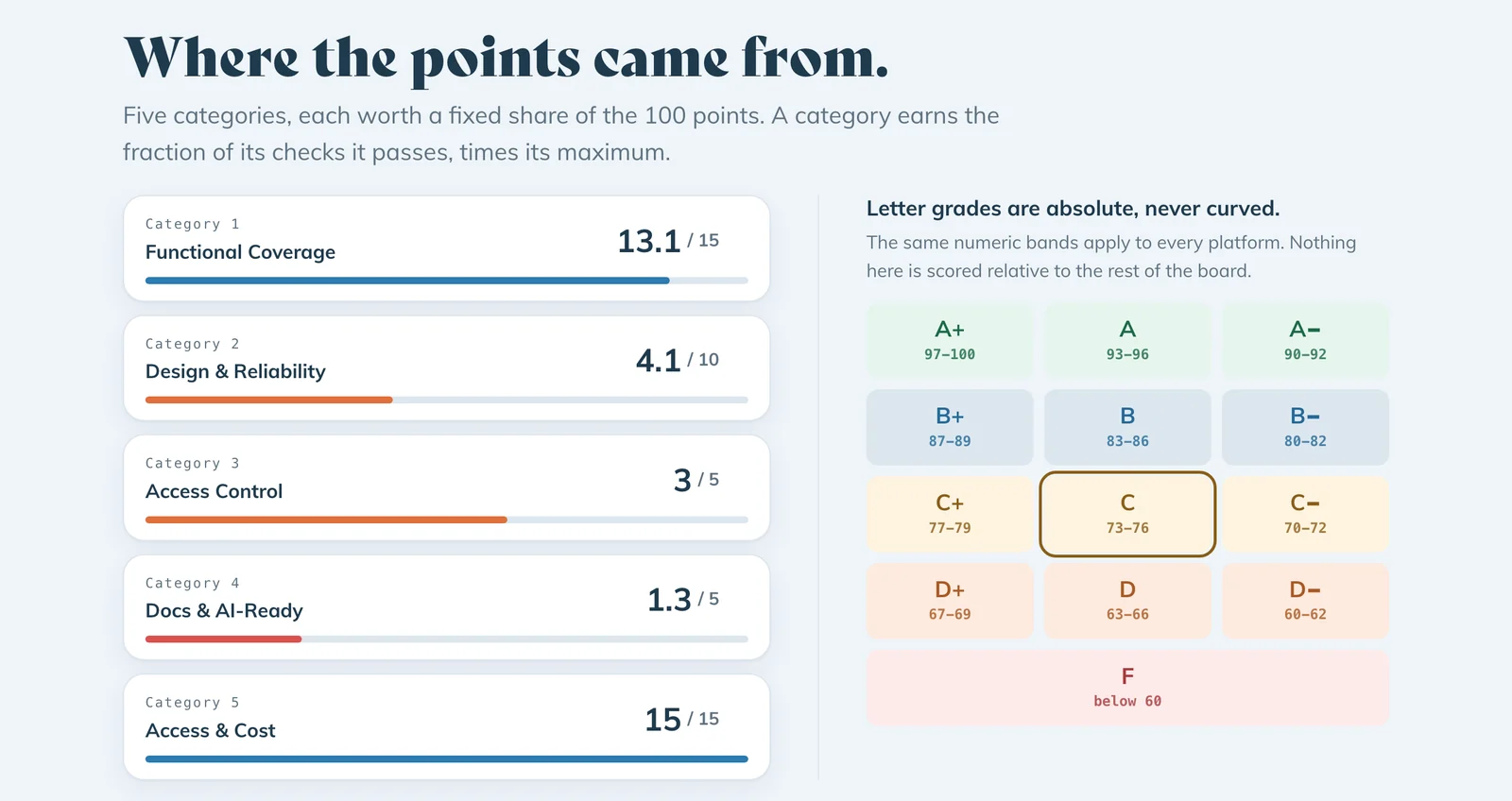
The rubric covers five categories:
- Functional coverage: Can you get the data and take the actions your business runs on, and change them?
- Design and reliability: Will your code, no-code tools, and agents behave predictably, or break?
- Access control: Can you safely give an app or agent a limited slice of access, then revoke it?
- Documentation and AI-readiness: Can a developer, or an AI coding tool, build against it easily and correctly?
- Accessibility and cost: Can you get in without a sales call or a forced upgrade?
How much each category counts is where I had to make judgment calls, especially pricing vs. technical capability vs. access. I'll come back to that below, because I want your input on it.
Here's the part I'm most proud of. Every platform gets probed once, then the AI grades it three separate times, independently. When those runs disagree, the tiebreaker is the evidence. No averaging.
And if a disagreement can't be settled, the report says so. It publishes the score along with what the score would have been under the other reading. If a grade is on the fence, you'll know.
You don't have to take my word for any of this. Download the grading file and run it yourself (the prompts and instructions are on the grading guide page). Grade a platform we missed. Re-run one we already did. You should land very close to what's published, and if you don't, I want to hear about it.
A lot of these scores are low (for now)
These are preliminary scores, and you'll see that a lot of them are low.
Naming and shaming isn't the point. The point is transparency, competition, and trust. A low score today is useful information for anyone shopping for software, and it's a pretty clear to-do list for the vendor.
Over the next 60 days, I'm hoping for two things.
Property managers: tell me what you think of the weighting and methodology. Those judgment calls on pricing vs. technical capability vs. access are mine, and I'm open to changing my mind.
Vendors: go after your low-hanging fruit. Documentation is a good place to start, and some of these scores can jump with very little effort. Any changes you make to your API will get picked up when we re-run everyone.
60 days from now, I'll rerun everything and lock in initial scores. After that, I'll re-grade roughly every 6 months.
If every vendor's score goes up, everybody wins. Vendors get to brag about their API, and we get to actually use it.
The goal here (as always) is to help property managers run a better business. Right now, a big part of that is knowing which software lets you use your own data.
So go check out the Report Card, click into the platforms you use, and review or download the full reports. If you spot a factual error, let me know and we'll fix it right away.
-Peter