Every June, I disappear for the entire month. No Slack, no email, no phone calls, and nobody on my team checks in with me. Four years running now, and nothing has caught fire.
This isn't a tiny shop. My property management company in Columbus, Ohio has 720 doors, 35 employees, and about $3.4 million in revenue per year. For a long time I took pride in being the most important person in the building. But if the company can't run without you, you own a job.
I'm an engineer, so I rebuilt mine like a machine. When I started, about 40 tasks had my name on them. Today it's four. This course walks through the three systems that got me there, so you can build your own. It's for PM owners who can't take a day off, let alone a month.
What you'll learn
- Build a weekly scorecard of 8 to 12 numbers that your leadership team runs the business from
- Map every task in your company to exactly one owner, a trigger, and a written how-to
- Shrink the list of tasks with your name on them down to the calls only an owner can make
- Replace binders and hallway questions with a Notion wiki your team keeps current
- Set the short list of reasons your team is allowed to contact you while you're gone
New courses land on YouTube first. Subscribe
Why your company can't run without you
Key takeaway
Owners get stuck for three reasons: only they see the whole business, every task lands on them, and they're the answer to every question. Each system takes one of those off the table.
For years, three things made me impossible to replace:
- Only I saw everything. I was the only person who could see the whole business at once.
- Every task landed on me. Whatever else happened, the work ultimately ended up on my desk.
- I answered every question. If anyone on the team was stuck, they came to me.
Each of the three systems in this course removes one of those.
Note
None of these are fancy. The scorecard is a spreadsheet and the task map is a table. I really like simple solutions.
System 1: The weekly scorecard
Key takeaway
Put your 8 to 12 most important numbers in one spreadsheet, each next to its goal, and read it with your leadership team every week.
The scorecard fixes the first problem: being the only one who can see the whole business. It's a spreadsheet, nothing fancy, and it takes six steps to build.
- Pick your numbers with the desert island test. If you were stranded on a desert island and could know only a handful of things about your business, which numbers would you want? If a number doesn't clear that bar, it doesn't belong on the scorecard.
- Put each number right next to its goal, so anyone can tell at a glance whether you're on or off.
- Add the trailing 13 weeks next to each one, so you're reading the trend.
- Write down who's responsible for each metric on the spreadsheet itself.
- Update it every week, and have the entire leadership team read it together in your weekly meeting.
- Act the same week a number slips. If something is off its goal, you see it that week, talk about it that week, and somebody owns getting it back on track.
That weekly read is where my leadership team runs the business. Nobody waits for a quarterly review to find out something slipped a month ago.
What's on mine
A few of the numbers on my scorecard:
- Median time to turn
- Total occupancy
- Work orders sitting open past 30 days
- Client satisfaction score
- Tenant satisfaction score
- Team happiness
Your list will look different, and that's fine. The win is that the whole team steers by the same numbers.
Before we had this, nobody was aligned on what mattered, or even what their goals were. Every person in every department chased whatever they personally thought was most important, and a lot of the time those priorities pulled against each other. I had the full picture. Everyone else was making decisions half blind, seeing only their own corner of the business.
Where this goes wrong
Scorecard bloat. Mine has grown to 18 rows over the years, because once you have a scorecard you want to put everything on it. You don't need 18. Start with 8 to 12 and only add a row when it earns the spot.
System 2: The task map
Key takeaway
One table, one row for every task the company does, and every row gets exactly one owner, a trigger, and a link to how it's done.
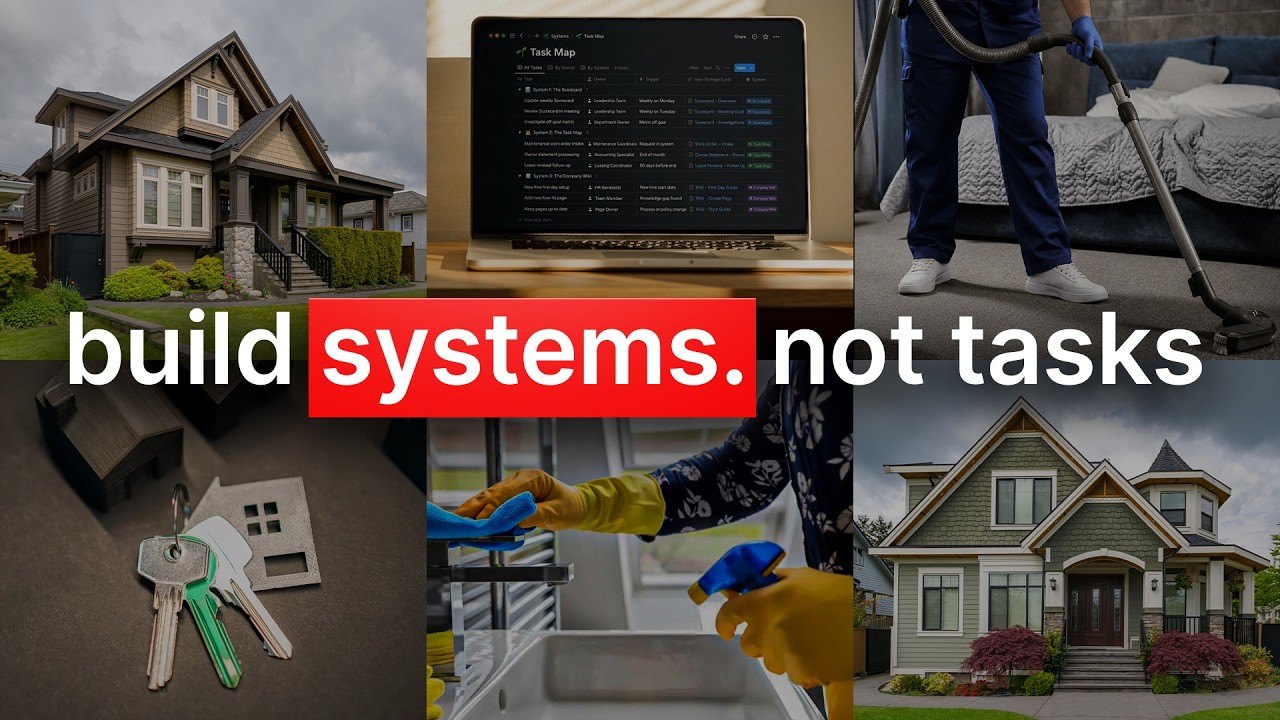
The task map fixes the second problem: every task landing on me. It's a simple table with one row for every single task the company does. Mine runs to hundreds of rows. It's not exciting to look at, but it might be the single most useful document I've ever built for my business, because it's the one place you can see who does what across the entire company.
Each row answers four questions:
| Task | Owner | Trigger | How it's done |
|---|---|---|---|
| Maintenance work order | A specific coordinator, by name | The request lands in our system | Link to the page that walks through it step by step |
Now multiply that row by everything the company does. That's the task map.
To build yours:
- List every task the company does, one row each. Expect hundreds.
- Give each row exactly one owner, a specific person by name.
- Write down what triggers the task, so the owner knows when it's theirs.
- Link the page that shows exactly how it's done. Those pages live in the wiki (system 3).
Before the task map existed, nobody knew who did what, and it was chaos. You can't take a day off with that kind of chaos in your business, let alone a month.
Real accountability is what lets you leave. If every task has exactly one owner and a written way to do it, the work doesn't stop just because you're not there to chase it.
Where this goes wrong
Without a task map, these show up fast: - Two people both think they own the same task. - Worse, nobody owns a task, and it gets dropped. - You start hearing "that's not my job." - Everybody does the same thing a little differently, so quality is all over the place.
From 40 tasks to 4
Key takeaway
Keep driving down the number of rows with your name in the owner column until only the calls an owner has to make are left.
The task map also gives you a scoreboard for yourself. The goal over time is simple: fewer rows with your name in the owner column.
When I first built mine, I had about 40 tasks with my name on them. Forty. Today I have four:
- Filing our corporate taxes
- Managing my COO
- Approving the annual budget
- Truly escalated issues, like lawsuits and regulatory problems
Those are the calls only an owner can make. Every other task the company does has somebody else's name next to it, a real owner, and I sleep well at night knowing it's being taken care of.
Getting from 40 to four is the biggest reason I can step away at all, and it's what people ask me about most. So I sat down and listed every box that had to be checked before I could vanish for a month. It's a free checklist: download it here. Take it and build your own.
System 3: The Notion wiki
Key takeaway
Get every answer out of your head and into one place, then answer questions with a link instead of an explanation.
The wiki fixes the third problem: me being the answer to every question. It's a full Notion buildout with every piece of reference information you need to do any job at my company. Think of it as a souped-up digital employee handbook combined with a company wiki. Everything is in there, from how to submit a credit card receipt to how to handle a tenant lockout.
Before Notion, every one of those questions came straight to me, all day long. That pattern had to break. If the owner's head is the only place answers live, the business stops the second they walk out the door.
Why binders didn't work
Notion replaced dozens of physical binders, and those binders failed for reasons you'll probably recognize:
- They were out of date almost instantly.
- Nobody ever pulled them off the shelf. Nobody opens a binder to figure out how to do their job.
- They were a nightmare to keep current. I'd be up late the night before a new hire's first day, updating and printing dozens of pages so they'd have everything they needed.
That same first-day page for a new hire now takes about 2 minutes to build in Notion.
How the wiki fills its own gaps
I run this routine every time someone brings me a question:
- Question comes in. Someone walks up to me with a question.
- Already in Notion? If yes, I answer with a link to the right page. Most of the time, that's the whole conversation.
- If no, we build the page together. I have them sit down right next to me and we write it in real time.
- Gap filled for good. The gap gets filled once, by the person who hit it, and it doesn't come back as a question. There's no better feeling.
It stays current, too, because everyone on the team is responsible for keeping their part of Notion up to date. The wiki is the backbone of the whole business, and I'm really proud of it.
Bonus: AI gets useful almost by accident
Key takeaway
Once everything your company does is written down in one place, AI tools suddenly have something real to work with.
This one falls out of the other systems for free.
- Notion AI answers team questions. Anyone on my team can ask it a question and get a straight answer back, without pinging their manager or digging through the hundreds of pages we have in Notion.
- The task map is a ready-made list of AI candidates. Because it lists everything the company does, you can go right down it and pick the jobs you want to hand off to an AI agent. And you've already got their instructions, because every row links to a how-to page.
That's a whole video on its own.
The mindset shift
Key takeaway
The hardest change wasn't any of the systems. It was accepting that my job is to hand the work to my team and get out of the way.
All three systems had to exist. But the hardest change was in my head.
For years I took real pride in how hard I worked and how important I was to the business. I was the guy who knew how to do everything and touched everything. So building a company that didn't need me felt wrong. It felt like admitting I was lazy.
I had two big worries:
- My clients would be upset that I wasn't handling them personally anymore.
- My team would resent me for stepping back while they were grinding.
Neither one came true.
What I had to see was that my job was to hand the work to my team and get out of the way. I used to think being the most important person in the building was a win. Now I know a company that runs fine without me in the room is worth more than being the guy everyone depends on.
When I finally brought the idea to my team, they were glad. They were excited for me. They'd watched me build this company from the start, and they figured I'd earned a real vacation.
How I actually leave for June
Key takeaway
Give your second-in-command a short, fixed list of reasons to call you, then fix every gap your first time away exposes.
My routine, four years running:
- On the last day of May, I give my COO the same three reasons, word for word, every year. The only reasons to contact me in June:
- You quit.
- The office building burns down.
- Something happens that stops us from operating as a business, like the Division of Real Estate coming in and shutting us down.
- Everything else waits until I'm back.
- When I'm back, I fix the system behind anything that came up. I clean it up, trace what caused it, and change the system so it can't happen again.
The first June wasn't totally clean. Our health insurance renewed right in the middle of the month, and I got an emergency call from my COO to sign the paperwork so nobody lost their coverage. A couple of other small things came up too. I cleaned it all up my first week back in July, and then (because I'm an engineer) I figured out what caused each one and fixed the system.
That was 3 years ago. Every June since has been completely clean. No calls, no emails. I don't check Slack, and I don't stop by the office.
The month off was never the goal. It's the clearest evidence I have that the system holds.
Resources mentioned
- Notion and Notion AI: where my company wiki lives, and the AI my team uses to search it.
- My month-off checklist (free PDF): every box I had to check before I could step away for a month.