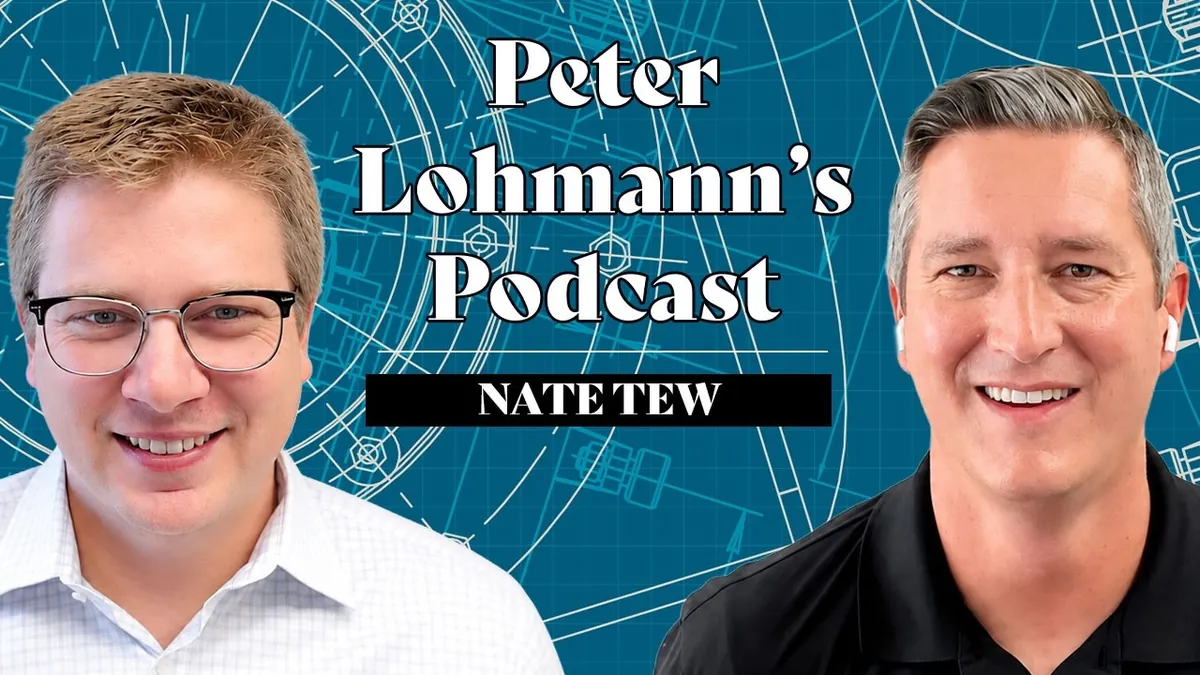
Most property management companies hit a wall somewhere between 75 and 100 doors. When Nate Tew came on my podcast, he told me the reason is almost always the same: the owner won't hire fast enough.
Nate is the co-founder and CEO of Keyrenter, a PM franchisor out of Salt Lake City with 94 sold locations, 80 open, and roughly 13,500 doors under management across the system. We've crossed paths at conferences for years, and I've always wanted to get him on the show to dig into how the franchise model actually works from the inside. This conversation delivered. Here are the ideas I keep thinking about.
The 75-to-100-Door Trap Is a Hiring Problem, Not a Revenue Problem
I asked Nate about the most common place franchisees plateau. His answer was immediate: 75 to 100 doors.
"It is a trap for those that are not willing to hire," he said. The pattern he sees over and over is an owner who waits to hire until they have "enough" revenue, or until the processes are perfectly dialed in, or until it feels safe. So they stall out, because they simply can't manage the portfolio alone anymore, and every hour they spend in the weeds is an hour they're not networking or bringing in new doors.
The fix is uncomfortable because it runs backwards. You hire before the revenue is fully there, take the leap, and grow into the cost. Nate's exact framing: those willing to "sacrifice a little bit to get there" do very well. The ones who wait for perfect conditions never move.
He sees a second version of this same trap at 200 to 300 doors, an awkward phase where you're building the team but it isn't complete. Keyrenter considers a team "complete" with a single pod at around 300 occupied doors. Below that, you're always in some in-between state, under-resourced, having to make a decision before you feel ready.
They Could Be Four Times Bigger, and They're Deliberately Not
The line from this interview that stuck with me most: Keyrenter turns down franchise buyers who can write the check.
"We could be two, three, four times our size right now if we were doing that," Nate said. Instead, every candidate goes through a one-to-one call of at least 30 to 60 minutes where he asks about their background, their family, sometimes their upbringing and their marriage. He shows them pictures of his kids. The point is to signal that this is a family-first organization, and to filter out anyone who treats culture and values as "huff and puff."
They screen against Patrick Lencioni's ideal team player framework: humble, hungry, smart (as in emotionally intelligent). Keyrenter added a fourth attribute, aligned, meaning aligned with the vision and mission. Humble comes first, because if someone isn't teachable, a franchise system is a miserable place for them to be.
This reminded me a lot of how we run Crane. We don't accept everyone who applies either, and the reason is the same: one bad-fit member changes the whole room. Nate's version of that discipline is just written into who he lets buy a franchise.
Model 300, and the Vision of "The Wealthiest Franchise Owners"
Nate is refreshingly specific about where Keyrenter is headed. He doesn't want 500 or 1,000 franchise owners. He wants 300 franchise owners who each get to about 300 doors across two to three territories, roughly 800 to 900 units per owner.
That's the Model 300, a growth framework they built over ten years of watching what works, in partnership with Profit Coach, and launched last year (there's a print version). It's the north star they hand a new owner: here's the path to 300 doors and beyond.
His stated goal is to have "the wealthiest franchise owners of any franchisor system." He walked me through the math: a billion dollars of systemwide sales, which he pegs at around $1.5 billion of enterprise value across all franchises, roughly 250,000 homes under management.
I appreciated how the framework started. When they first franchised in 2015, Nate wanted a big, comprehensive manual. Then he read The Checklist Manifesto and threw that plan out. The phrase that got him: the only people who benefit from a big handbook are the people who wrote it. So they built the Keyrenter Method as a set of checklists covering the most important elements, then let each owner build on top. His honest admission about the early days: "We were building the airplane as we were flying it."
The 80% Rule, and Why Perfectionism Keeps You Stuck
We spent a good chunk of the conversation on the mindset that traps owners in the technician role, and here Nate and I are cut from the same cloth.
He named two culprits. First, the perfectionist "nobody can do it better than me" reflex. Second, something closer to a Puritan work-ethic guilt, the feeling that if you're not in the trenches with everyone, you're not earning your keep. The belief that effort is a moral good. He's had both. So have I.
His antidote comes from Daniel Pink's Drive: get a task to 70% yourself, hire someone at 70%, train them to 80%, and then praise them to death while ignoring the last 20%. What happens next is the interesting part. People who feel praised start closing that gap on their own, and they often blow past where you'd have landed. The owners who struggle do the opposite, harping on the missing 20% until turnover spikes.
I brought up a number I've written about before: the error rate of the average US office worker is about 3%. You cannot build a multi-million dollar business on the expectation of zero mistakes. You build the system to withstand a 3% error rate. Nate's addition was the upside nobody warns you about, which is that as you grow you get to hire people who are genuinely better than you at specific functions, and until you've met that person, you don't even know how high the bar can go.
"Bad Owners" Usually Aren't the Problem
I closed by asking Nate for a sacred cow in our industry he disagrees with. He gave me three: that lower fees win business (fee discounting as your whole value proposition), that more doors solve everything, and the one that clearly bothers him most, the reflex to blame owners and tenants.
"I don't like it when our industry says that owners and tenants are the problem," he said. Sure, some owners aren't cut out to hold rentals. But in his experience, the vast majority of relationships that go off the rails do so because of poor leadership and management on the PM side: expectations that were never set, an effort to get everyone on the same page that never happened. His challenge was blunt: hand those same "bad owners" to a manager who operates the right way, and you'd see very different outcomes.
I mostly agree, and I told him why. I started my career as a systems-and-process maximalist, because I'm wired that way and because most PMs are underinvested in systems, so leaning hard into process worked for a long time. Then around 600 to 700 doors we plateaued, and I hit the ceiling of that philosophy. I've had to dial it back and put more weight on people and relationships. We recently moved from a departmental structure to a pod-hybrid model, with a dedicated property manager assigned to every owner. It's early, but owner churn should drop and referrals should climb. Nate's point is that the system and the relationship work together, you need both, and most of us over-index on one.
If there's one takeaway from this conversation, it's this: the thing capping your growth is almost never the thing you're blaming. It's usually a hire you haven't made or a relationship you haven't tended.