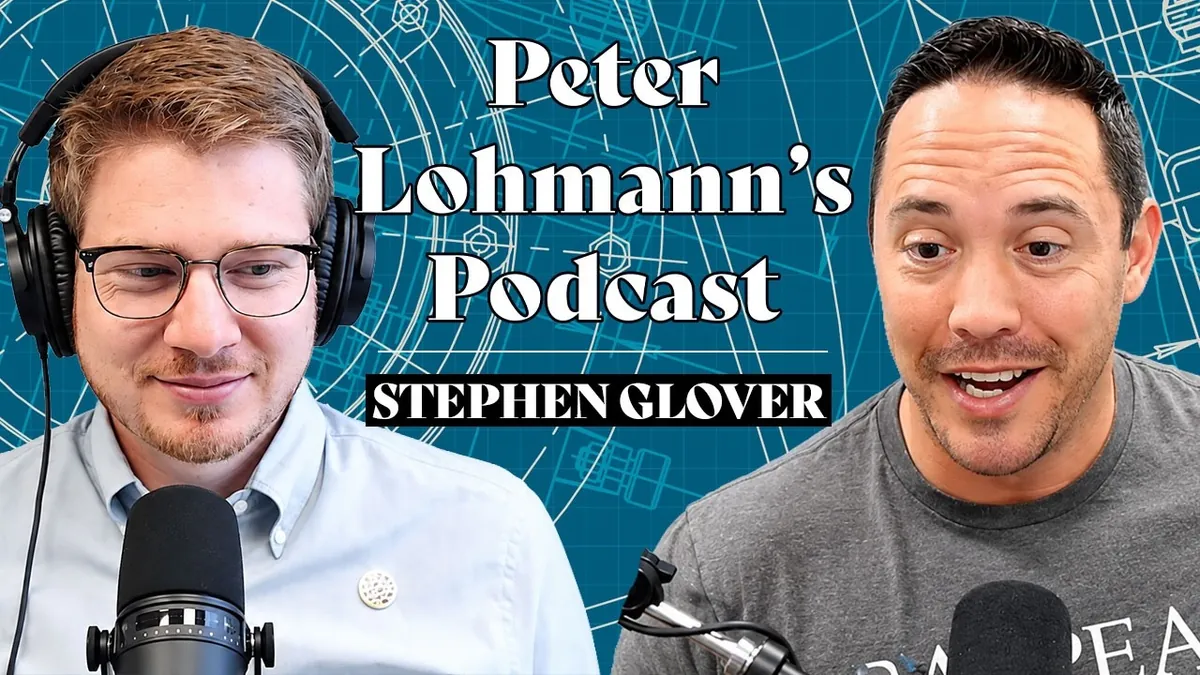
I've lost hundreds and hundreds of clients running my own property management company. So when Stephen Glover told me Peak Property Management went roughly five years without losing a single owner to a bad experience, I needed him on the podcast to explain how. Stephen is CEO of Peak Property Management in Richmond, Virginia, where he now manages around 1,300 doors after intentionally parting ways with a large client earlier this year.
The ownership rule I wasn't sure I believed
I pushed back on Stephen pretty hard on this one. I'm fine owning it when we actually mess up. But what about when we didn't? An owner won't drop the rent and the unit sits empty. A tenant uses a self-showing lockbox and someone breaks in. The invoice math is correct down to the penny, but the owner still feels like something's off. None of that is our fault, or is it?
Stephen's answer: there's almost always something. Not proof that Peak did something wrong, but a place where the process could have been tighter or better communicated. On the rent example, maybe the sales conversation didn't make it explicit enough that Peak would recommend price cuts once a property sat too long, and that gap belongs to Peak. On the break-in, Peak chose self-showing lockboxes because they lease faster, which is a real tradeoff made on the owner's behalf, so some of that risk is Peak's to own too.
Where Stephen actually draws the line with an owner isn't the first incident, or the second. It's the third or fourth time the same conversation has to happen. At that point, the mistake isn't the incident anymore. It's that Peak didn't fire that owner sooner.
I run my business on process and data. Stephen runs his on relationships and instinct. But the habit he described isn't really about either one. It's a decision to look for your own fingerprints on a problem before you look for the client's.
Growth introduces a new kind of churn
For years, Stephen did every sale himself, hour, hour-and-a-half conversations at coffee shops before an owner ever signed a management agreement. By the time they got to the paperwork, they weren't buying a leasing process. They already trusted Peak.
That doesn't scale past a certain door count. Somewhere around 700-800 doors, Stephen hired a business development manager whose job was closing new business, not spending ninety minutes building a relationship with each prospect. Churn ticked up almost immediately, and the reason was simple: the owner no longer had Stephen's cell number. They were talking to a property manager instead of the founder, and the reassurance that came with that direct line disappeared with it.
That's the tradeoff nobody advertises about scaling past a founder-led sales process. You get volume. You give up some of the trust that used to close the deal for free. It lines up with something I found digging into our own numbers with LeadSimple last year: the median property management sales cycle runs closer to three or four months, not the thirty-to-sixty days most operators assume. If your growth plan assumes a fast, low-touch close, you're probably underestimating how much of your close rate has actually been you.
The checkbox trap
As Peak's churn crept from around 8% toward 15%, Stephen's team dug into why. The problem wasn't a broken process. It was that every process had quietly become a checklist, and the team's mindset had shifted from "did we take care of this resident" to "did I check the box." Checked boxes create a specific kind of defensiveness. When an owner complained, the instinct was "I did what the process told me to do, so this is on you."
Peak's fix was almost cosmetic on the surface: they removed the word "process" from the company vocabulary entirely. Move-in process became move-in experience. Move-out, onboarding: same treatment across the board. But the intent behind it wasn't cosmetic. A checklist measures completion. An experience measures outcome, and that forces a different question at every step, not "did I do the task," but "how did this actually land for the person on the other end."
I'll admit this one stung a little. My whole operation is built on exactly the mindset Stephen described: heavy process, checkbox-driven, engineer brain. And I recognized the defensiveness immediately: an owner is upset, and my first instinct is "well, we did everything right, look at the checklist." That's not the same as actually caring whether the outcome was good for them.
Not every client is a fit
Twice this year, Stephen fired a large client on purpose, once at 150 units, once at 300. Both times, the pattern looked the same: the owner had previously self-managed, lived near the properties, and depended on the rental income to cover current living expenses rather than treating it as a long-term investment. Every maintenance call became a fight over a few hundred dollars. Every vacant day felt personal. On one portfolio generating six figures a month in rent, the owner capped repair approvals at $500, which meant something like a broken HVAC unit could drag on for weeks while a tenant went without.
Compare that to the clients Peak has never lost: investors using rental income to build long-term wealth rather than fund this month's bills. Those owners think in years, not invoices. A $2,000 repair that keeps a resident renewing doesn't register as a loss to them. It registers as protecting an asset.
The takeaway is narrower than "avoid hands-on owners." A management company that markets itself to everyone will eventually take on clients whose financial situation makes them structurally impossible to satisfy, no matter how good the service is. Knowing which owner you're actually built for, and being willing to say no to the rest, is as much a retention strategy as anything you do after they sign.
Where that leaves me
Five years without a lost client isn't a service-quality trick. It's a specific set of habits: own the outcome before you look for who's at fault, expect some relationship equity to evaporate the moment you stop doing sales yourself, watch for your team quietly turning care into compliance, and be selective enough to only take on owners who actually want what you're offering.
Full episode with Stephen Glover: