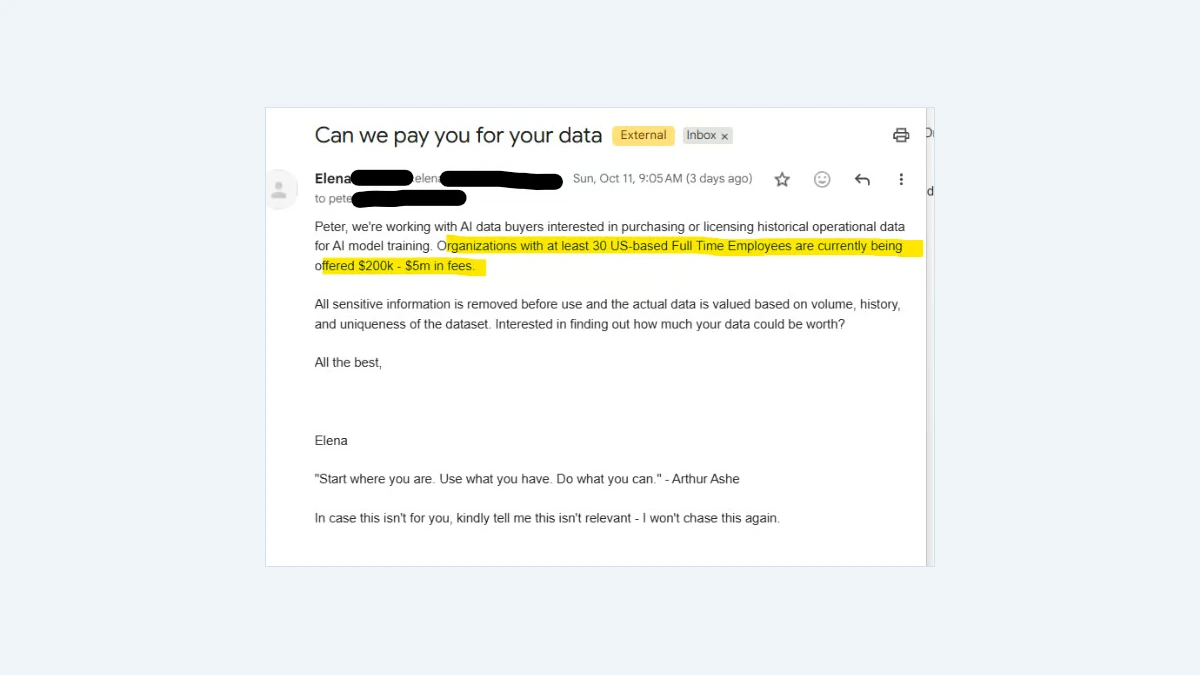
Last week a cold email showed up in my inbox asking if I'd be interested in selling my property management company's data to train AI.
My gut said scam. My second guess was that propertymanagement.com had finally decided to say the quiet part out loud.
Wrong on both counts. I spent the next several days pulling on this thread (including a call with one of the buyers), and it led me into a brand-new market that's about to get very crowded. AI companies want to teach their agents how real businesses run, and they're writing big checks to operators for the raw material.
If you own a PM company, some version of this email is headed your way. Before it lands, you should know who's buying, what they pay, and why I'm saying no for now.
What AI Data Buyers Want From a PM Company
They want the record of how work gets done inside your business. micro1's data partnerships page asks for SOPs, knowledge bases, CRM data, project histories, and documentation of how teams evaluate information and make operational decisions. Polyshares casts a wider net: Slack, email, Google Drive, CRM history, support tickets, and call recordings.
When I asked micro1 what they'd want from a company like mine, the short version was "everything." Any system with business data in it is fair game, including software you stopped paying for years ago.
Translate that into PM terms and you can see why we're interesting to them. Follow a single work order from the resident's first message to the vendor invoice. Add the email thread where an owner fights a repair estimate and your team talks them into the right call, or the notes your leasing coordinator leaves when choosing between two applicants. That trail of judgment calls is the hard part for an AI agent to learn, and most of us have thousands of them sitting in our systems.
micro1 put it this way when I asked:
"We are looking for data that reflects how work is actually performed within an organization. The most valuable datasets capture real operational expertise, decision-making processes, and repeatable workflows that help AI systems learn how work is executed in real-world business environments."
The buyers aren't after your owner list or your tenants' phone numbers. They say personally identifiable information gets stripped out on the way in. micro1 says it works from de-identified data, and Mode says its process removes identifying and sensitive information. (Whether that fully protects you is a separate question, and I get into it below.)
Where Your Data Ends Up
micro1 and its peers turn this data into training environments for the frontier AI labs, companies like Anthropic and OpenAI (the makers of Claude and ChatGPT). Picture a simulated workplace where an AI agent practices a real job before anyone lets it loose on a real one. MIT Technology Review describes vendors building these as training gyms for tasks like debugging IT systems and drafting legal briefs.
Now picture an agent running maintenance triage inside a fake PM office built from a real operator's ticket history. That's the product, and our data is the practice field.
What It Pays, and Who's Buying
Here's a partial list of the buyers active right now:
- micro1: Tiers of $100K+, $500K+, and $1M+. Wants operationally mature companies with 30+ employees.
- Polyshares: $100K to $2M. Polyshares acts as the buyer itself and says it pays net 30 to 60 days after the data is approved and anonymized.
- Mode: Advertises $100K to $5M, with a minimum of 20 full-time U.S. office employees. The bar drops to 10 employees for accounting firms and six for law firms, which tells you whose data the labs want most right now.
- SimpleClosure: Winds down failed startups and sells their leftover data. Per Forbes, it has done roughly 100 deals in the past year at $10K to $100K per company.
For a sense of the ceiling, Google agreed to pay $10 million for bankrupt Spirit Airlines' internal records, outbidding the AI data company Mercor for a haul that included around 100 million emails and 500 million Teams messages.
A whole layer of middlemen has popped up around these buyers. Data brokers promise to shop your records for the best offer, and several buyers pay generous referral fees. Mode's referral program pays the greater of $50,000 or 6% of the seller's payment. With that much money going to whoever sends a deal over, an unbiased take on the downsides is hard to find. (I have a referral link too, and I disclose it at the bottom.)
Why This Market Is About to Explode
On October 9, micro1 committed to spend $1 billion over the next 12 months acquiring enterprise operational data, with financing from Citi and Hercules Capital. Four days later, Mode announced a "$5 billion" program of its own.
Business Insider reports business owners receiving six-figure offers that expire in 48 hours, alongside Instagram ads promising millions to anyone willing to license their data.
When a buyer has to deploy $1 billion in 12 months, the outreach gets aggressive. PM companies sit on years of messy, judgment-heavy records, and the buyers know it.
Why I Wouldn't Sell (At Least Not Yet)
We're agents, and the data isn't cleanly ours. A PM company acts on behalf of its owner clients. Owner statements, repair approvals, years of correspondence about their properties: do those records belong to us, to the owners, or to both? Nobody has a good answer yet, and I doubt many of our management agreements contemplated an AI data license. The lawyers are nervous too. One attorney who advises AI startups called this kind of data "legally radioactive," and an Emory law professor pointed out that no federal law bans these sales while arguing employers should get express consent first. Remember that your team's Slack DMs are in the pile.
Confidentiality is one of our core duties. Remember OLD CAR? In most states, an agent owes the principal Obedience, Loyalty, Confidentiality, Accounting, and Reasonable Care. Anonymization scrubs names. It may not scrub the business picture of an owner's portfolio: their rents, their expenses, the repair they deferred, the fight with their tenant. If a client asked me point-blank whether I'd sold that, I'd want a clean answer.
It could cost you at exit. I asked Bill D'Alessandro, a former investment banker, how a buyer would view this. His answer: "If you sell data, you will have to disclose it to a potential buyer. It might spook some. Others might value the company less than a different target because they were hoping to sell the data and now they can't. They may also be put off by the open legal questions around your sale of the data." A multi-year exclusive license is exactly the kind of surprise that turns up in diligence.
Exploding offers are a red flag. A legitimate buyer paying six figures for a data asset can give you a week to call your attorney. Mode, for what it's worth, publishes a 14-day nonbinding letter of intent process. A cold pitch paired with a 48-hour deadline should make you suspicious by default.
The Best Arguments for Selling
If I had to argue the other side, I'd make these points:
- The incentives on anonymization cut your way. If a buyer botches a seller's data, its pipeline of future sellers dries up. The brokers and labs have every reason to get this right.
- The window may be short. Once the models understand how PM companies operate, they won't need much more from us. MIT Technology Review expects data prices to stabilize within the next year.
- A long hold changes the math. If you don't plan to sell your company for 5+ years, the concerns of some future acquirer carry less weight today.
- Data from a defunct company is in high demand. If you're holding records from a business that has closed, buyers are especially interested.
If You Decide to Sell Anyway
When I talked with micro1, they described a two-year exclusive license, meaning I couldn't sell the same data to another broker or lab during that period. They also told me to expect a 48-hour exploding offer. (For the record, I don't plan to sell my data at this time.)
If you go down this road, do your homework before the clock starts:
- Read your management agreements and call your attorney first. A 48-hour window is no time to discover what your PMA says about records.
- Pin down scope. Ask which systems and date ranges they want, and what gets excluded (screening reports, owner banking details, HR files).
- Ask who handles de-identification, and whether you can review samples before anything leaves your hands. micro1 says sellers can.
- Confirm the structure. Make sure it's a license, that you keep ownership of the underlying data, and that you know exactly how long any exclusivity runs.
- Plan on disclosing it. If you sell your company down the road, the buyer will find out. Keep the paperwork clean and ready.
If you want to see what micro1 would offer for your PM company's data, you can start with my link. Using it helps support my newsletter. Don't say I didn't warn you, though.
I'll keep watching this market closely. If you go through with a deal, I'd love to hear how it went.
This is not legal advice. Talk to your attorney about this.