
Every property management franchise will tell you how many locations it has. Almost none of them will tell you what those locations actually make. Three years ago I tried to solve that with public data. This year, I went back and checked my work.
Back in October 2022, I compared the four major property management franchises: costs, revenue per unit, location counts, everything I could pull from public filings. Around the same time, I was kicking around a franchise alternative with Jon Matzner called "PM Business in a Box." It never went anywhere. But my interest in what these franchise systems actually deliver never went away either.
So this time I pulled every Franchise Disclosure Document (FDD) each system has filed since 2022, straight from the Wisconsin and Minnesota regulators who require them (links at the bottom if you want the source data yourself). Short version: the category grew about 30%, the two big systems hit a wall, and the smallest one is the only franchisor willing to tell you what its franchisees actually earn.
The Category Grew, But Not Evenly
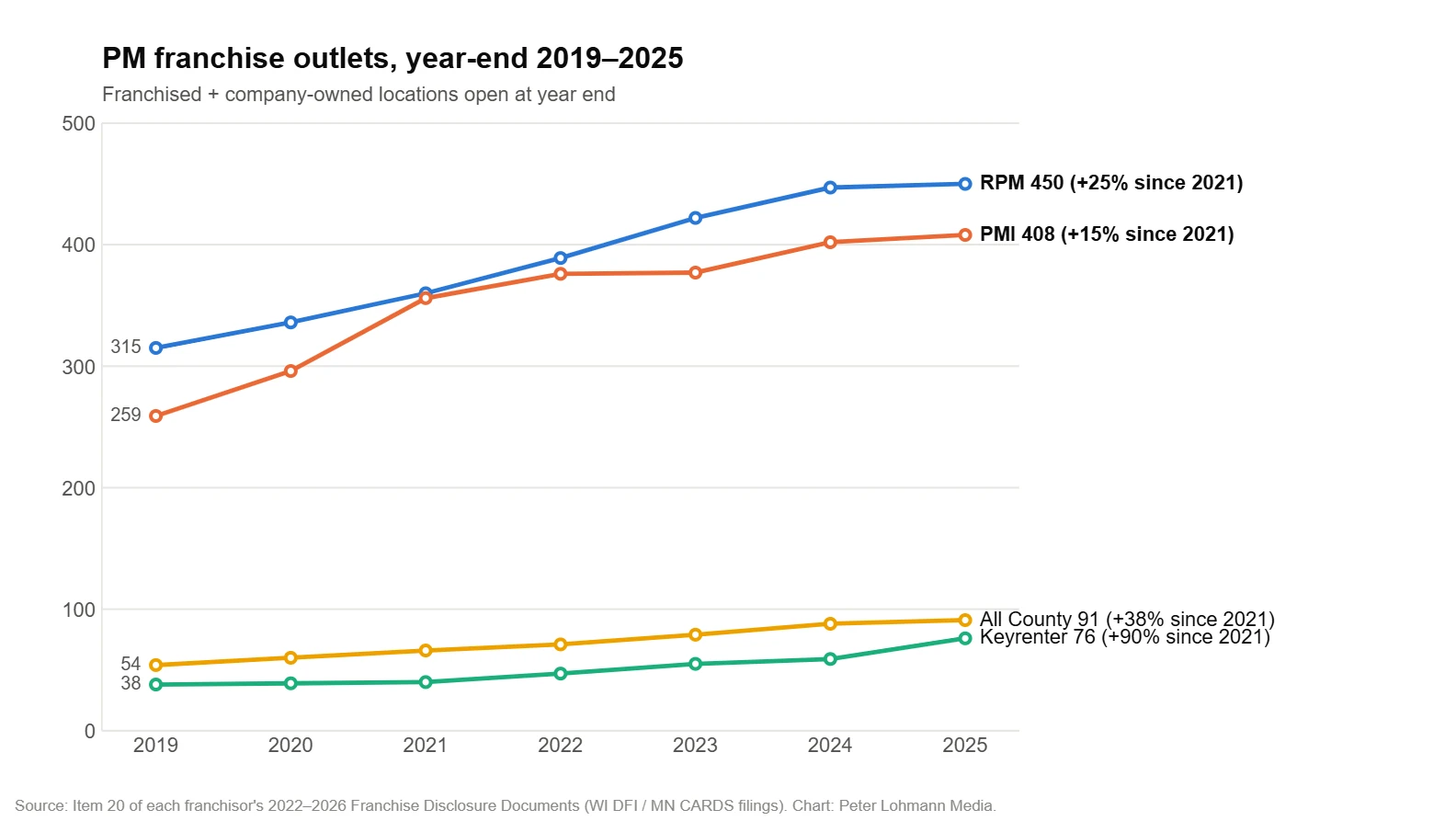
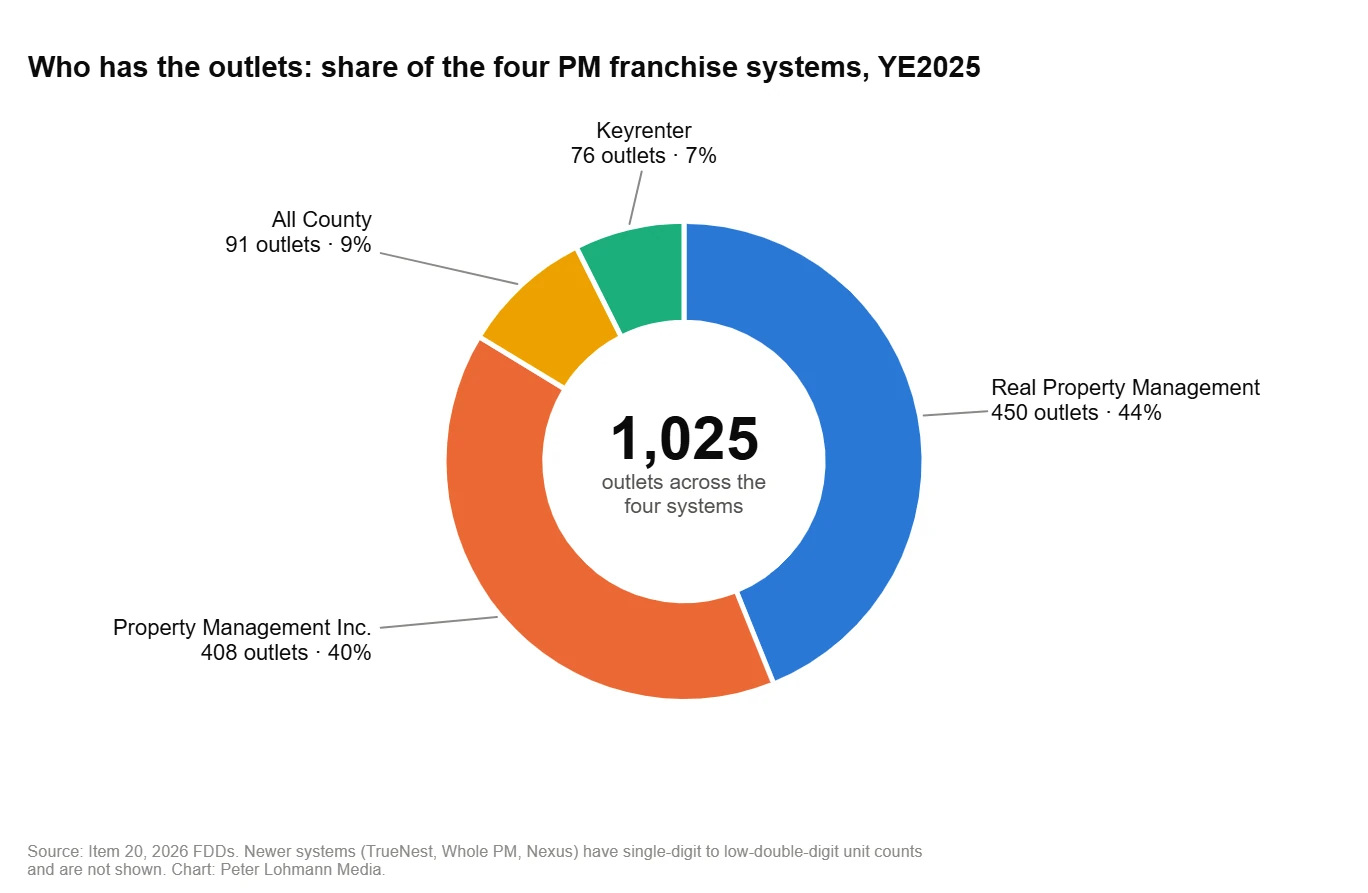
Real Property Management (the Neighborly brand, owned by PE group KKR) added 90 outlets since 2021 and now sits at 450. But 2025 itself was rough: 31 new openings against 28 closures (19 terminations, 7 non-renewals) for a net gain of just three locations. The pipeline is thinning too: signed-but-unopened deals fell from 21 to 11.
PMI tells a similar story at 408 outlets. It opened 57 in 2025 but lost 50, and 38 of those exits were logged simply as "ceased operations - other reasons," with no further explanation. My guess, purely anecdotal, is that a good chunk of that is M&A within the network: existing franchisees buying each other out rather than the brand actually shrinking. I interviewed PMI's CEO, Steve Hart, about this earlier in 2026.
Keyrenter is the real growth story here, going from 40 to 76 outlets, including 20 new openings in 2025 alone. Worth flagging, though: their press releases claim 101 "locations," while the FDD shows 76 open plus 11 signed. Press releases count territories sold; the FDD counts doors actually operating. I also talked with Keyrenter's CEO, Nate Tew, this year.
All County keeps plodding along at 91 outlets, except 10 of those are now company-owned, up from just 2 in 2019. The franchisor is quietly becoming an operator, not just a seller of franchises.
Nobody Wants to Tell You What Franchisees Actually Make
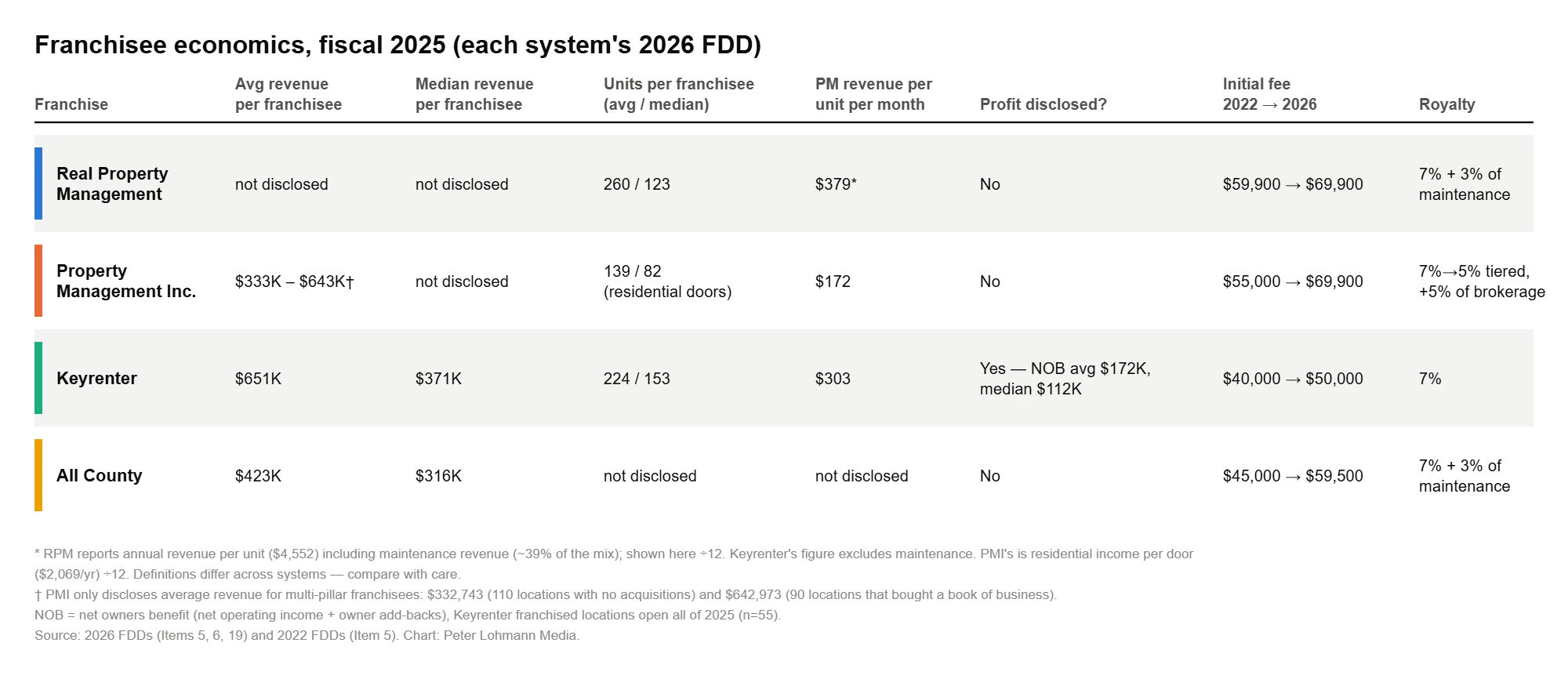
This was my complaint in 2022, and it's still true: only Keyrenter actually discloses franchisee profit. For their locations open the entire 2025 fiscal year, the median "net owner benefit" (operating income plus owner add-backs) was $112K on $371K of median revenue ($139K for offices open three or more years). One outlier location doing $4.5M in revenue drags the average up to $172K, which tells you how skewed that top end is. My honest read: that's probably typical of all four systems, and it's not a great number.
RPM discloses only revenue per unit: $4,552 per year, or roughly $379 a month including maintenance, up 26% from the ~$300/month figure I cited in 2022. Sounds like progress until you pair it with the other number in the filing: the median RPM franchisee now manages 123 units, down from 182 in 2021. More revenue per door, on fewer doors. Whether that nets out to a better business is exactly the question RPM's disclosure doesn't answer.
The Franchisors Are Charging More, Not Less
I called the 7% royalty expensive back in 2022. That figure hasn't moved, and everything around it has gone up. All four systems raised their initial franchise fee: RPM and PMI both now sit at $69,900, up from $59,900 and $55,000, respectively. Worth knowing if you're evaluating one: most or all of that fee typically goes to the business broker who sold you the territory, and the figure is usually negotiable, so the sticker price isn't necessarily what anyone actually pays.
The more revealing number is buried in PMI's audited financials: $19.6M of franchisor revenue in 2025, and 55% of it came from franchisees buying products and services from PMI, more than the company collected in royalties. The franchisor's real business, increasingly, is selling things to the people who already pay it a cut of their revenue.
Three New Entrants, and One Zombie Brand Reborn
Three new PM franchisors have shown up since 2022, none with real traction yet: TrueNest (South Florida, franchising since 2024), Whole Property Management (Virginia Beach, part of John Hewitt's Loyalty Brands; zero franchised units open, one company-owned store in Denver doing $1.7M), and Nexus (Rhode Island, a handful of franchisees).
And Renters Warehouse, which quit franchising a decade ago, was bought by Japan's GA Technologies in 2024 (a story I broke at the time) and has since been rebranded RENOSY.
What This Means If You're Actually Weighing One
A franchise is, at bottom, a system and a brand you're paying to license instead of build yourself. These filings are the closest thing to a receipt for what that system and brand are actually worth once you net out the fees. On the numbers above, that math isn't obviously in the franchisee's favor at two of the four systems. And the two systems growing fastest aren't the ones being straightest with you about what a location makes.
My take: these franchisors need to figure out how to be profitable without pulling so much gross revenue out of their franchise partners. Cut better deals with the software vendors, and pass all of those savings down instead of layering another product line on top of the royalty.
If you want to check my work, here's the source data: the RPM, PMI, Keyrenter, All County, and Whole PM 2026 FDDs, and prior years on Minnesota's CARDS search.
-Peter