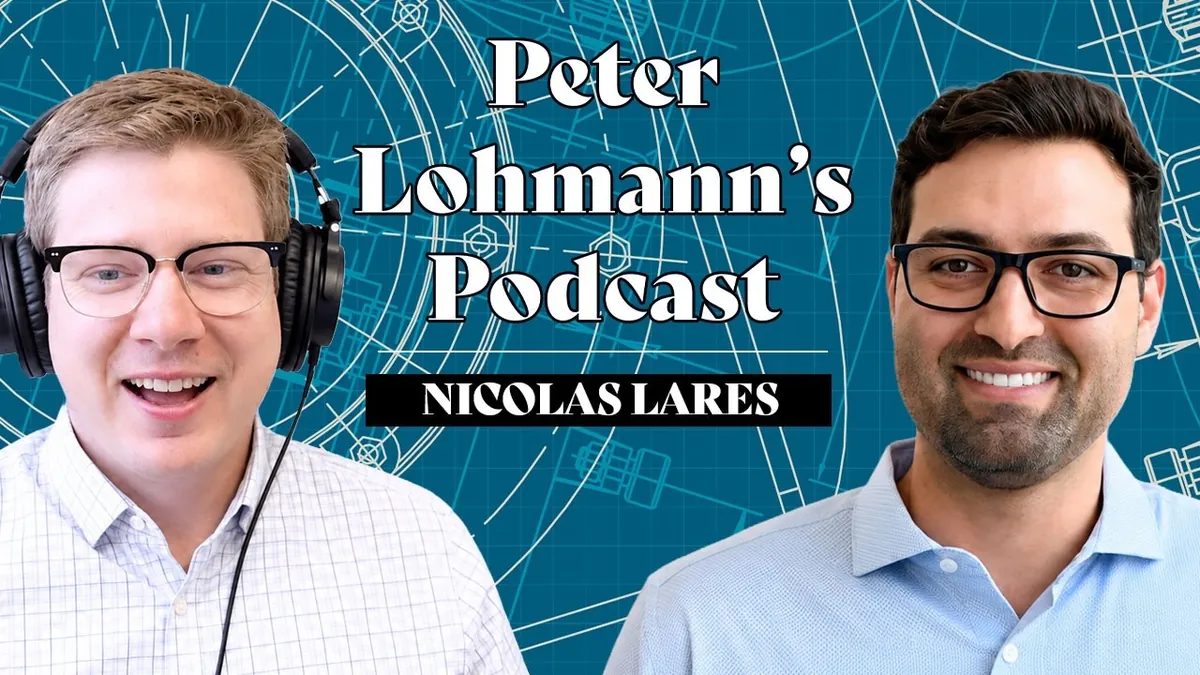
I've owned rental property since 2008, across multiple properties, and I've never once filed a claim on any of my single-family policies. Most operators I know can say the same. So when a guest came on my podcast and told me those premiums could partially come back to me, I did what I always do with a too-good-to-be-true pitch: I pushed back. Hard. Repeatedly.
The guest was Nicolas Lares, founder of Insur3Tech, a platform that places property managers and rental owners into captive insurance structures. We spent an hour on it. I ended the conversation genuinely interested and still not sold, which is exactly the right place to be with something like this.
Here's what I learned, and where Nicolas and I disagreed.
What a Captive Actually Is
Strip away the jargon and a captive is a co-owned insurance company. That's the phrase Nicolas kept coming back to, and it's the useful one.
In traditional insurance, the money moves in a straight line: you pay a carrier, the money leaves your account, and it's theirs. In a captive, that line bends into a loop. You pay premium, and you simultaneously own a piece of the insurance company on a prorated basis of what you paid in. If the company generates a surplus at the end of the year, the profit gets distributed to shareholders, and in this structure, the shareholders are the customers.
Nicolas put the logic simply: if an insurance company's whole goal is to generate a surplus and hand it to shareholders, why not make the customers the shareholders?
He got into this by accident. Furloughed early in COVID, he joined a family friend's insurance business helping insure Amazon's last-mile delivery van network. He says they grew it to nearly $300 million in premium before the carriers decided to exit the market, which forced them to build a captive from scratch so their customers wouldn't lose coverage. That's the origin story, and it's worth knowing because it shapes everything he believes about who traditional carriers actually serve.
Where I Pushed Back
Nicolas's framing (and you'll see this if you follow him on LinkedIn) leans toward the idea that traditional insurance is one-sided and unfair. You pay every year, and you get nothing back unless something bad happens.
This is where he and I disagreed, and I didn't let it go.
That's not unfair. That's just insurance. Of course you don't get your premium back in a year you don't file a claim, because that year, somebody else insured by the same company did file, and the money has to exist to pay them. You could buy a policy on January 1, have a catastrophic loss on January 2 having paid almost nothing, and they'll pay it in full. Where's the fairness to the carrier in that.
I made a second point too. If insurance companies were the risk-free money printers this framing implies, you could go buy their stock, or start one yourself. The reason most people don't is that running one is hard. Carriers don't just collect premium and pay claims. They adjudicate claims, fight fraud, invest the float, administer the plan, chase people who don't pay, and defend lawsuits that sometimes run to a state supreme court. Nicolas himself said 40 to 50% of a carrier's expenses go to something other than paying claims. That real cost is the work of running the business, not a scam.
My honest read: what carriers do is specialization, plain and simple. I could grow all my own food, but I go to the grocery store because someone else is better at it. I'm fine with an insurance company earning a normal profit for taking work off my plate.
To his credit, Nicolas didn't fully concede but he sharpened the argument in a way that landed. His real point isn't that carriers are villains, it's that for hard physical assets with a fixed replacement cost, there's no runaway-lawsuit risk, so a captive can offer the same coverage with an optional profit return on the back end. Same contract, same payout terms, but one version lets you see money back in good years. Framed that way, I get the appeal.
The "Above-Average Driver" Problem
Here's the pitch that made my skeptic alarm go off loudest: if you're a low-risk operator, you keep more of your premium instead of subsidizing worse operators in a shared pool.
The trouble is I've never met a real estate operator who thinks they're average. Every single one tells me they run a tight ship, screen great tenants, and have never had a fire. It's the survey where everyone rates themselves an above-average driver. And with property, claims are so rare that four or five clean years tells you almost nothing. Statistically, most operators go clean for years regardless of how they actually run things.
Nicolas's counter was the most interesting thing he said all episode. From insuring thousands of Amazon drivers, he argued the signal isn't whether you've had a claim, it's whether you correct. An operator whose drivers hit poles in year one, who then coaches them and sees those claims disappear, is a good risk. One who's still hitting poles in year five will be hitting them in year twenty-five. Translated to our world: a property that keeps filing deposit-alternative claims because it isn't screening residents, then adds a real screening process and watches those claims dry up, has shown you something real. And captives, like carriers, can non-renew an operator whose loss history turns bad. The traditional market is always there to fall back to.
I still think the rare-event nature of property claims makes this harder to assess than driver telemetry. But the corrective-action lens is a genuinely better way to think about operator risk than a raw claim count.
The Question I'd Actually Ask
Near the end I asked Nicolas the question that matters most: what am I not asking about? What's the real risk?
His answer wasn't the one people fixate on. Everyone worries the reinsurance company won't pay out if catastrophe strikes. These captives are federally regulated with reinsurance backing, so that's not the scary part. The scary part is renewal. He's watched novel insurance programs launch with fanfare, collect premium happily for a couple of years, and then get dropped by their reinsurer, leaving the whole structure unable to operate. Most reinsurance sits in London or Switzerland, and it's the single biggest cost line, in his estimate 25 to 35% of the program.
So the honest question isn't "will my captive pay claims." It's "what happens to my captive if the reinsurance doesn't renew?" The answer: find new reinsurance (probably at higher cost), find another captive if your loss history is clean, or go back to the traditional market. That market isn't going anywhere.
That's the frame I'd bring to this if I were seriously evaluating it. Understand the fixed expenses. Ask what percentage of every premium dollar actually sticks if no claims happen. And assume the projected returns are a long-run average, not a yearly guarantee. One bad event can erase several good years, which is the entire nature of insurance.
My Takeaway
I came away thinking captives are genuinely worth understanding, and not the scam-buster their loudest advocates sometimes make them out to be. The structure is old: communities pooling money to rebuild each other's homes is literally how property insurance started. What's new is that it's becoming accessible to smaller SFR operators, not just 10,000-unit institutions.
But interesting doesn't make it right for you. This is a newer product wrapper on an old idea, with real questions around fixed costs and reinsurance longevity. If you explore it, go in as a skeptic, read the expense line first, and don't let anyone tell you the premiums you've been paying were a rip-off. They weren't. They might just have a better home.
None of this is financial or insurance advice. It's a recap of one conversation and my own reactions to it. Do your own homework and talk to people who owe you a fiduciary duty before you move real money.