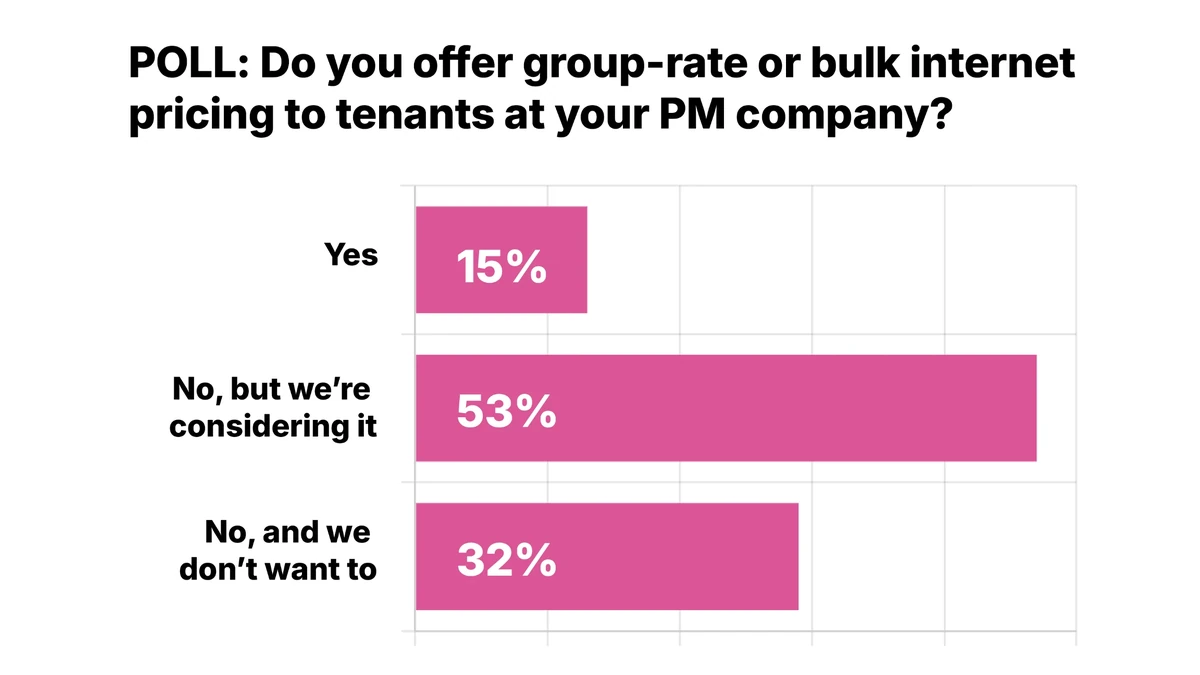
Group-Rate Internet (GRI) is one of the fastest-growing resident benefits in property management, and something I'm seriously considering adding at my company. I polled my newsletter audience, and 53% of them are interested in adding it too. But what is it actually? And how is it different from internet offered to residents by utility concierge companies?
GRI mechanics
The GRI provider negotiates a wholesale rate with major internet providers, generally in the $40s/month for gig-speed fiber service with no install/equipment/data-cap fees. The property manager enters into an agreement with the provider to purchase internet from the provider at some or all of the properties that they manage. Then, the PM sets a markup and offers to include it in the lease for qualifying properties, typically price-locked for a few years.
Before moving on let's define some terms, because this is slightly confusing:
- Bulk internet is what millions of large apartment units run on. The owner signs a long contract (often 7 years) and commits specific units, so it's a mandatory program. Conservice offers this, mostly to multifamily owner-operators. It doesn't really work for third-party managers, because we can't commit an owner's units for that long.
- Group-rate internet (GRI) is more flexible: no 7-year term and no minimum unit commitment. Second Nature appears to have pioneered this SFR-geared alternative to Bulk Internet.
- Internet Concierge providers have been around forever in our space (think Citizen Home Solutions and similar). They simply negotiate affiliate deals with the ISPs, handle setup for/with the resident, and share the ISP affiliate revenue with the property managers. Importantly with these programs, the PM is not billing residents for internet; they pay the ISP directly. It's a one-time transaction, not a billing & tech support relationship like the above 2 programs.
Importantly, how GRI is offered to tenants isn't always as straightforward as it seems on paper. Eg - can you make it required? Should you? How much should you charge; can you make a real profit on it without gouging residents?
So I did some research and put together some key info on group-rate internet, with a few things to watch out for before you offer it at your company.
NOTE: This is not a sponsored post, and there are no affiliate links. This is just a topic I've been curious about.
The critique
I've heard some interesting feedback from PMs who have already implemented GRI, and one vendor even pressure-tested these programs against real address-level pricing and brought some interesting points to my attention:
- Across hundreds of test addresses and 20+ PM companies, this vendor has "never found one priced below the ISP's direct rate at that address." They report that typical GRI markups run anywhere from 10-65% over ISP retail pricing. NOTE: this is a small sample against millions of rental properties and ~31k PM companies, so weigh accordingly.
- Recent data shows that only about 32% of American households actually have gig-speed internet, per FCC data. This vendor's internal data is slightly lower, showing roughly 30% of users picking full gig speeds when given the choice.
- The wholesale rate itself isn't always a bargain compared to direct ISP promo pricing. The vendor claims its direct-purchase data shows advertised promo prices are usually honored as billed, not inflated later, and are lower than most GRI pricing.
- They argue that, while some GRI pricing only pays off over multiple years of service, tenants typically sign one 12-month lease at a time. A resident who leaves after one year will have paid the markup in full without ever seeing the multi-year value the pricing was built around.
A caveat on the source. This vendor sells a concierge model, so it has a real stake in how GRI gets perceived. I haven't been able to validate its data. Weigh the claims above with that in mind.
I'll address these points one at a time:
First, the gig-speed number is probably understated. Per this vendor's research, most tenants with a real choice land at 100-939 Mbps. But 939 Mbps is what ISPs consider gig service, and the vendor's "30% pick gig" figure seems to leave those plans out. And even if the average tenant chooses a 300-500 Mbps plan, the price gap between half-gig and full-gig is often deliberately small (an ISP upsell), and a fair markup on GRI can make up for that.
Second, internet needs are changing. Work-from-home file uploads, posting on video social apps such as TikTok, video calls, and livestreaming all require substantial download AND upload speeds. While cable/copper internet often looks fine on download speed, it usually fails to deliver on upload. They are NOTORIOUS for this; it's outrageous. In fact, until I made some big changes a couple of months ago, the cable internet at my house AND my office both had upload speeds below 40Mbps. Fiber (where most full-gig speeds are offered) runs near-symmetrical, something I learned when I switched my own Columbus office this year.
On promo reliability: fair, and I can't counter it with my own data. But Broadband Facts exists because promo pricing wasn't reliable enough for the FCC to leave undisclosed (more on this later). If group-rate flat pricing is genuinely more honest than that, it strengthens the case for GRI, as long as the markup stays reasonable. As I understand it, GRI covers additional install/equipment/data-cap fees, which is often more transparent than ISP promo fine print or buried Broadband Facts.
On lease term vs. tenancy: pricing off a 12-month legal minimum doesn't reflect how PMs operate. RL's average tenancy is 4.5 years, close to the industry norm. I'd rather price based on how long the average resident who stays past year one pays, even though nobody can promise that at signing.
These are just my thoughts. I still encourage everyone to do their own research in their own market. Concierge programs still have their place and are undeniably simpler to implement. I personally know dozens of property managers doing very well with those programs. Don't consider this a full-throated endorsement of GRI; I'm just exploring the concept and sharing what I've learned during research.
Check the broadband numbers yourself
Since April 2024, ISPs must publish a standardized "Broadband Facts" label: the real price, including what it becomes after a promo. Almost nobody checks it. I pulled one for a Columbus address: $50 promo at checkout, $110/month on the label, plus $20 activation and $50 install. This is where direct ISP pricing can be tricky. Sometimes it's transparent and straightforward; other times, a million fees or stipulations are buried in the actual pricing. With the help of AI, it's easy to do a quick check for local ISPs in your area. Here's an example:
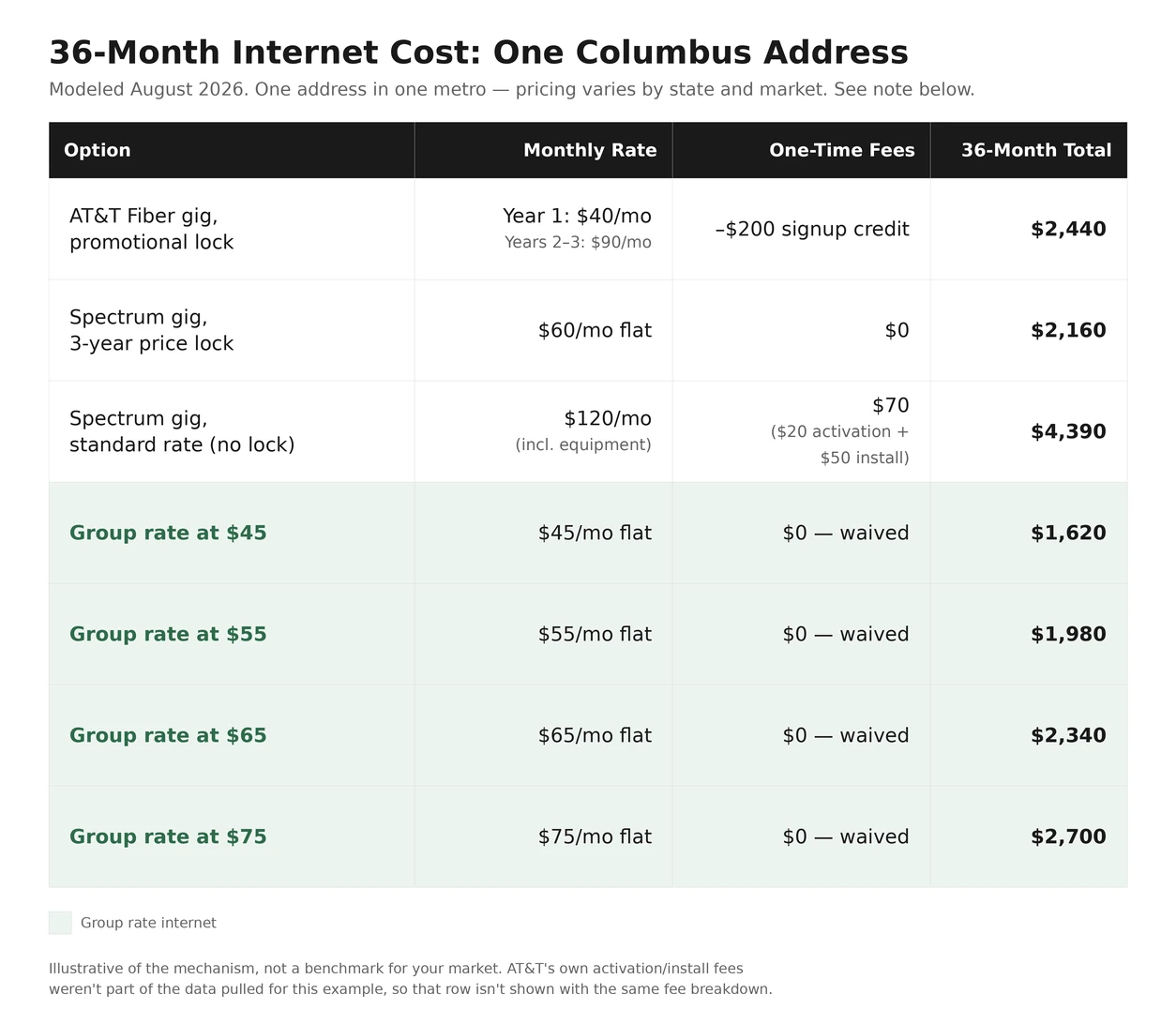
As you can see here, once we hit the $65/month flat fee (a $25 markup from the PM), group-rate internet starts to be less competitive than other options in my area. Again, pricing varies by state and market, so pull your own numbers.
A few suggestions:
- Check the prices yourself. Pull the Broadband Facts label for your own addresses across multiple ISPs rather than taking anyone's number at face value.
- Position it as included, with an opt-out. Second Nature suggests copy along the lines of "high-speed internet comes included with the home at an exclusive group rate," with residents free to opt out. Make the opt-out option clear in the listing, application and at lease signing.
- Set a fair markup, so your GRI is at or below the best retail pricing available (and tell residents this).
Andrew Smallwood, CSO of Second Nature, told me that with GRI "our customers have consistently seen properties lease up to 2-5 days faster than those without group rate internet. We've never had a product launch with more demand, the value is incredible."
Expect more companies to begin offering GRI, and more property managers to begin adopting it. Will you be one of them?
-Peter