If there's one number that determines whether your property management company is built to thrive or built to struggle, it's Revenue Per Unit (RPU).
ProfitCoach calls RPU one of the six "do-or-die" metrics for residential PM companies, and I agree completely. It defines the revenue side of your unit economics. Basically, how much money do you have to play with for each door you're expected to manage?
If this number isn't good, your world will be pain until you fix it. No matter how fast you grow, no matter how low your churn, and no matter how hard you work, nothing will be fun or easy until you right-size your RPU. You must start here.
How to Calculate RPU
The math is simple. Take your total company revenue (ignore brokerage and maintenance revenue), divide by the average number of doors you managed throughout the year, then divide by 12 to get the monthly figure.
TOTAL REVENUE ÷ AVG. NUM. DOORS ÷ 12 = RPU
Here's my own company as an example. RL Property Management did $2.03M in management revenue in 2025 and managed an average of about 700 doors through the year.
$2,030,000 ÷ 700 ÷ 12 = $241/month
That's our RPU. Not a vanity metric - a survival metric.
What "Good" Looks Like
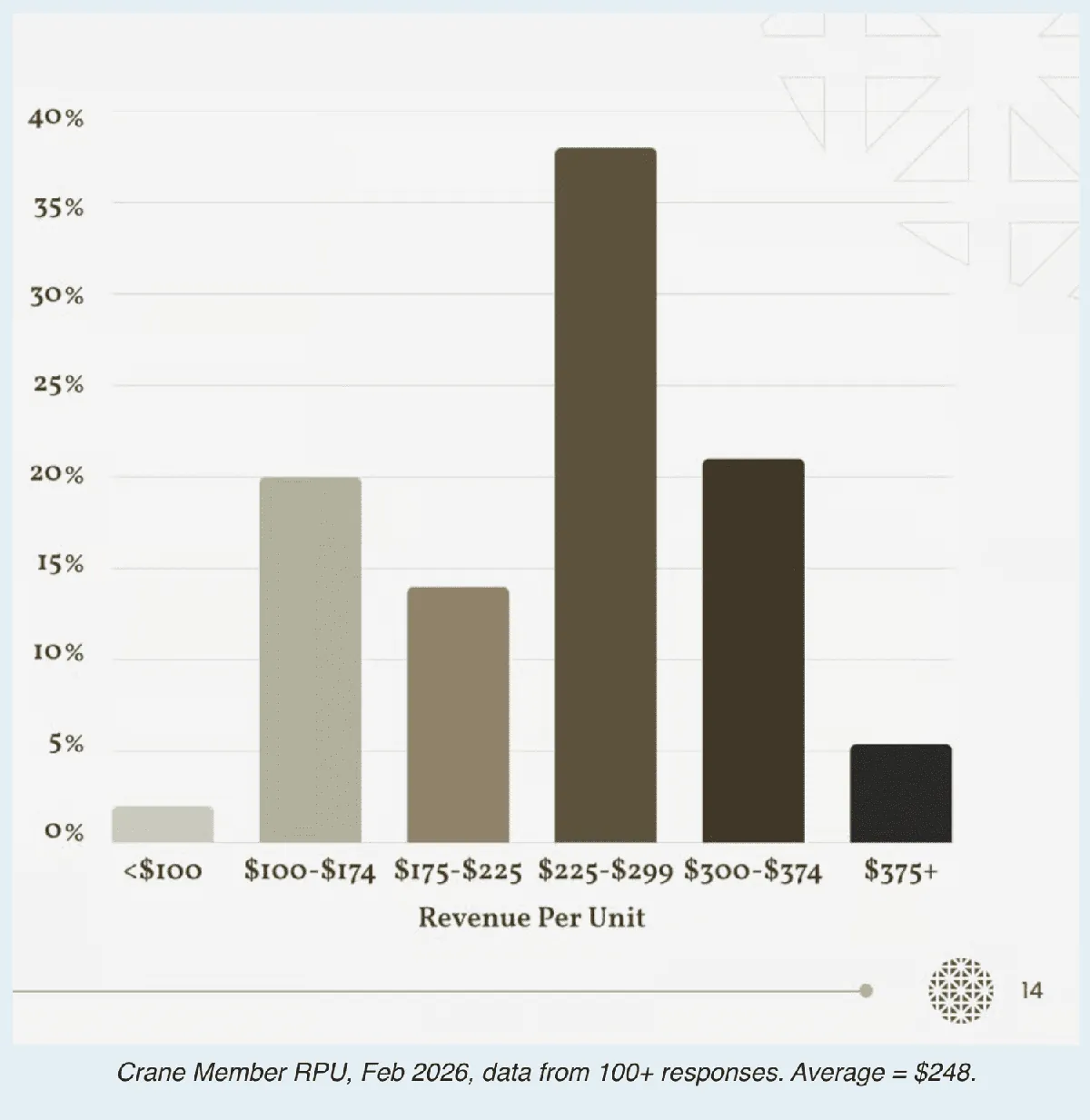
We recently surveyed 100+ members of Crane (our private PM operator community) and calculated their RPU. The average came in at $248/month.
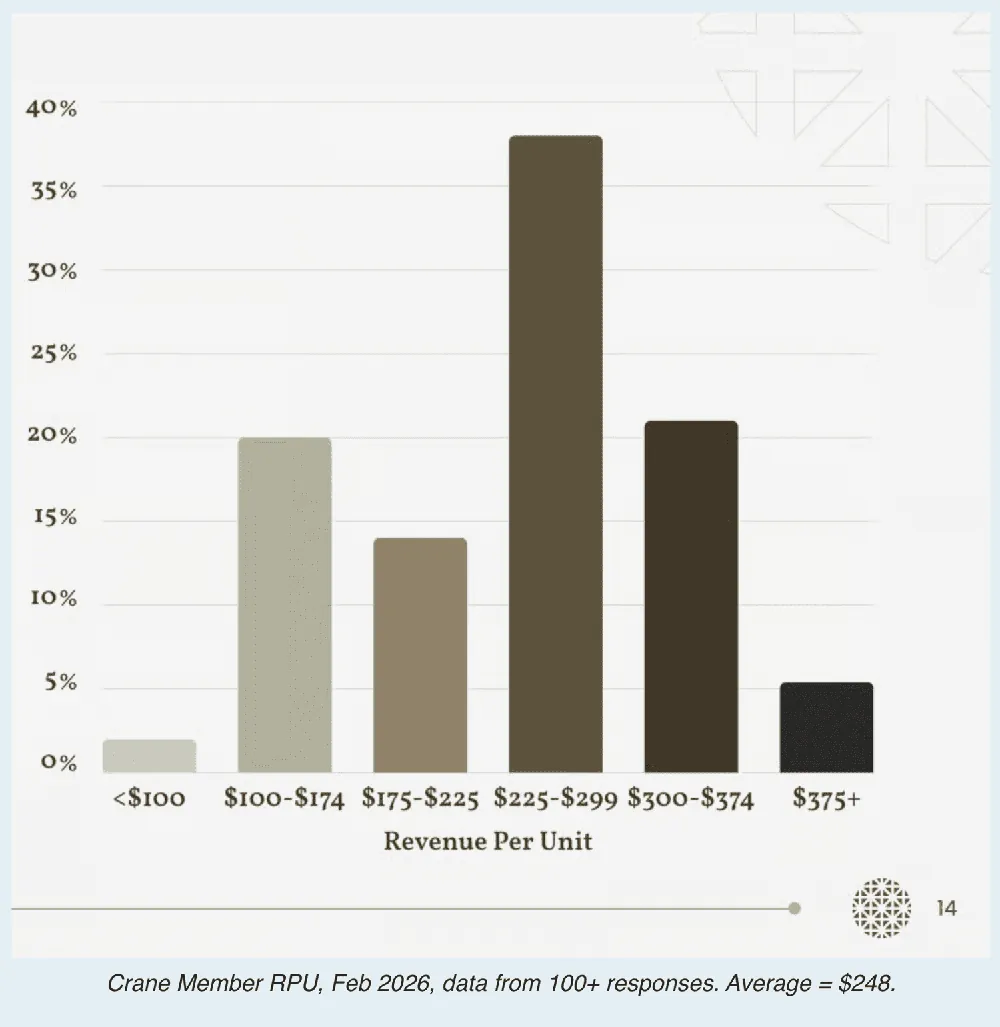
ProfitCoach's research found the broader industry average was $222 back in 2021. But here's the number that matters: the top 25% most profitable management companies had an average RPU of $317. That's the benchmark, though you don't need to hit it to run a great, profitable business.
ProfitCoach also provides a useful framework for setting your RPU goal based on average rent in your market:
Average rent under $1,000: RPU should be 20–25% of average rent
Average rent $1,000–$2,000: RPU should be 15–19%
Average rent over $2,000: RPU should be 10–14%
For RL, that pegs our recommended RPU somewhere between $247–$312, so we're right on the edge of that range at $241. Not bad for a company that doesn't charge leasing fees.
Why RPU Matters More Than You Think
ProfitCoach puts it bluntly: "A 10% increase in RPU can easily lead to a 100% increase in profitability."
That's not hyperbole. All else equal, any increase in your RPU drops straight to the bottom line. You're not adding headcount, not adding overhead - it's pure profit. There are very few levers in a PM business that work this cleanly.
If your RPU is below the recommended figure for your market, this should be your #1 business priority. Full stop.
How to Raise Your RPU
The great news is you have a lot of flexibility in how you get there. Here are a handful of ideas to consider (all of these must be fully disclosed and agreed to by both parties):
Fee adjustments:
Raise your management fee on new owners
Raise your management fee on existing owners (make exceptions freely)
Increase leasing fees and lease renewal fees
Revenue capture:
Start charging a markup on third-party work orders (or increase your existing markup)
Keep late fees and other miscellaneous tenant fees instead of passing them to the owner
Charge owners for listing photos (incorporate into the turn scope)
Charge for utility setups and transfers
New revenue lines:
Introduce an annual technology fee (or similar) for owners
Introduce tenant benefit programs (e.g., resident benefit packages) and behavioral fees
That's just what I could think of off the top of my head, but there are dozens more. Todd Ortscheid at PMAssist has an entire course dedicated to this topic if you want to go deep.
The Bottom Line
RPU isn't glamorous. This is back-to-basics stuff. Nobody gets into property management dreaming about spreadsheets and fee schedules.
But for many of you, fixing your RPU is the single highest-leverage thing you can do for your business right now. It's your constraint. The math is brutally simple, but so are the fixes.
Pull your numbers. Learn where you stand. And if you don't like what you see, start there.