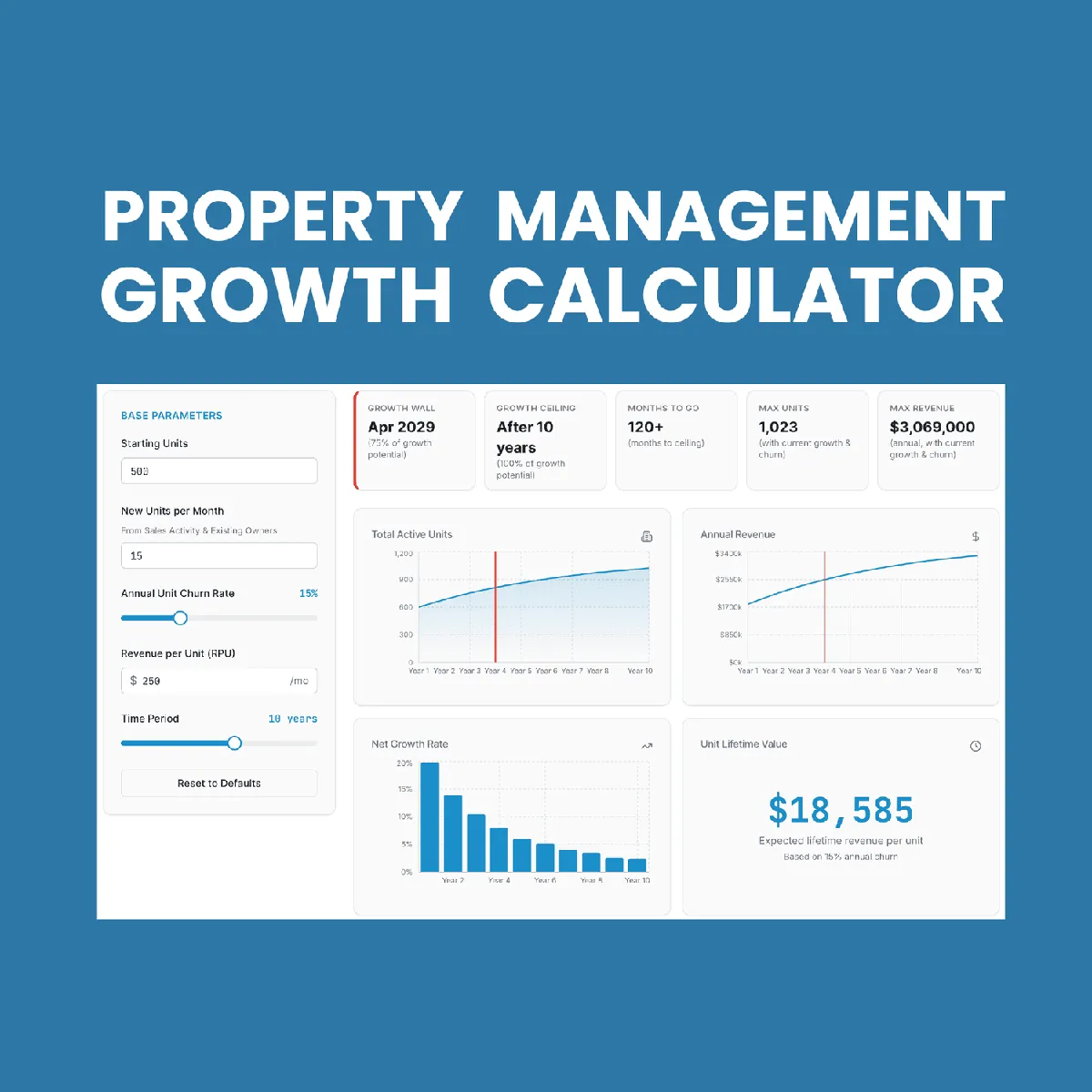
2026 Update: Visualizing the Growth Wall
A couple years ago, I published this blog and figured it would resonate. But… crickets. (Original post below.)
Turns out, nobody wants to plug numbers into a formula just to feel bad about their growth ceiling.
So I fixed it. I built a free, interactive Property Management Growth Calculator that makes it dead simple to understand your revenue ceiling and how close you are to hitting it.
Try the calculator here
Or watch this quick video where I walk through an example:
As a refresher: your revenue ceiling is the theoretical limit your business will plateau at if your churn and growth stay constant. It’s the moment when you’re adding the same number of units each month as you’re losing.
This hits harder as you scale, because churn is a percentage - and percentages scale. Adding more doors doesn’t magically increase your lead flow, but it does increase your “leakage” through churn.
So you hit a wall.
And what’s worse? You hit it slowly. Your growth just… fades. From 10% to 7% to 5% annually. Barely beating inflation. Sound familiar?
This is what I call the Growth Wall: about 75% of your theoretical max size. If you’re near that red line in the chart, growth is already stalling.
The calculator helps you:
See your projected ceiling based on actual data.
Tweak assumptions (like churn or new units/month) to see how they impact growth.
Spot the invisible forces slowing you down.
Bottom line is: you can’t fix what you can’t see.
Hope this tool helps you punch through the wall (or better yet, push it further out).
Let me know what you think.
—Peter
Original Blog Post from 2022:
If you run a business with recurring revenue, you probably understand the importance of churn. Known as the “silent killer”, churn is a measure of how many of your existing customers leave in a given time period. So if you start February with 50 customers, and 2 of those leave, that’s 4% monthly churn (or 48% annual churn).
We’ve all been advised to keep our churn as low as possible, because it’s very expensive and obviously makes it more difficult to grow. I’ve internalized this, and have been watching churn carefully at our property management company for many years.
What I failed to recognize was that churn, plus 2 other key metrics, literally defines a revenue ceiling for your business. The issue is that since churn scales with the size of your company (in other words, your churn may remain at a constant 4% monthly, but the actual number of customers that represents increases as your company gets larger). It follows naturally that unless you add more and more customers per month, your business will approach a size limit where you’re losing as many customers per month as you’re adding. And customer growth does NOT scale linearly with company size the way churn does, at least not in my experience. You don’t get more customers for free as you get larger unless you have a super-viral startup or something. But you DO lose more customers “for free” as you get larger.
To find your company’s revenue ceiling:
Take your average customer monthly revenue (eg. $600).
Divide that number by your monthly churn (eg. 3%).
This gives your CLV (customer lifetime value) in this example, $20,000.
Now multiply that by the number of new customers you’re adding per month (eg 10).
$20,000 x 10 = $200,000. This is your maximum monthly revenue possible.
Multiply by 12 to get your annual max revenue, 2.4M in this example.
Unless you change your churn, customer monthly revenue, or new customers per month, your business will quickly and then slowly approach this revenue ceiling.
This “ceiling” actually works both ways. If you do a tuck-in and buy a book of business from a competitor to leapfrog over this limit, but your metrics remain the same, your revenue will slowly shrink down to the revenue ceiling!
I was introduced to this idea by Alex Hormozi in this video.