Last December, Jordan Muela and I commissioned Harris Poll (the same outfit that does presidential polling) to survey 500 small landlords across the U.S. about what they actually think about property managers.
This is our second annual PM Trends Report. We just wrapped a 90-minute live webinar walking through the data with our partners at ShowMojo, ProfitCoach, and Property Meld.
The full report is 75 pages, free, and not email-gated at pmtrends.com. Go grab it, share it with your team, hand it to your investors, paste it into your sales deck. We want it out in the world.
I wanted to share my top 10 findings for anyone who'd rather read than watch the recording.
(And before I forget, a huge thanks to our title sponsors, Rentvine and Column.)
How we did the work
Quick context on the methodology before we dig in:
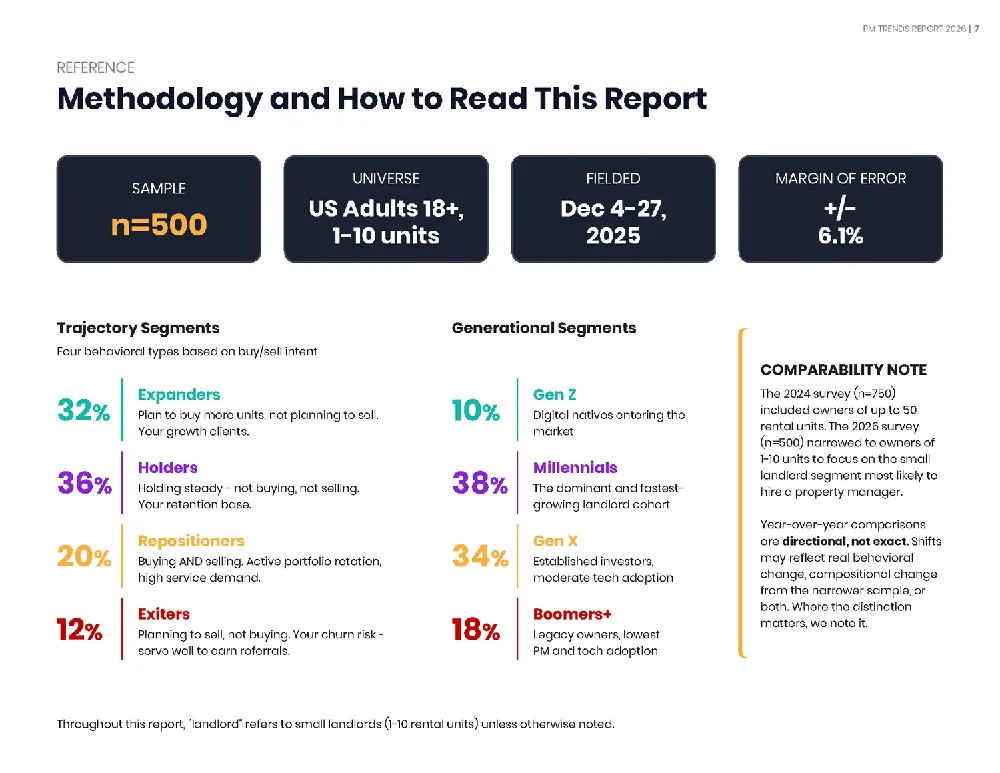
Audience was 500 small landlords who own 1–10 rental units (80% own 1–5)
Fielded December 4–27, 2025 by Harris Poll (Project P160614)
Roughly half currently use a property manager, half don't
Last year we surveyed landlords with up to 50 units. This year we narrowed to 10 and below, because that's the population most likely to hire a property manager and the population most of us actually serve. Year-over-year comparisons are directional, not exact.
The big methodological upgrade was segmentation. Alongside the standard generational cuts (Gen Z, Millennials, Gen X, Boomers), we sorted respondents into four "Trajectory" buckets based on their 12-month buy/sell intent:
Expanders (32%) — buying more, not selling
Holders (36%) — not buying, not selling
Repositioners (20%) — buying AND selling
Exiters (12%) — selling, not buying
I was honestly skeptical of this cut when Jordan first proposed it. By the time we finished the analysis, it was the most useful lens in the entire report. Behavior splits sharply along these lines - way more than I expected.
Okay. Let's get into it. Keep in mind this is a fraction of the total slides and findings from the report. I highly recommend downloading and digging into the entire thing here.
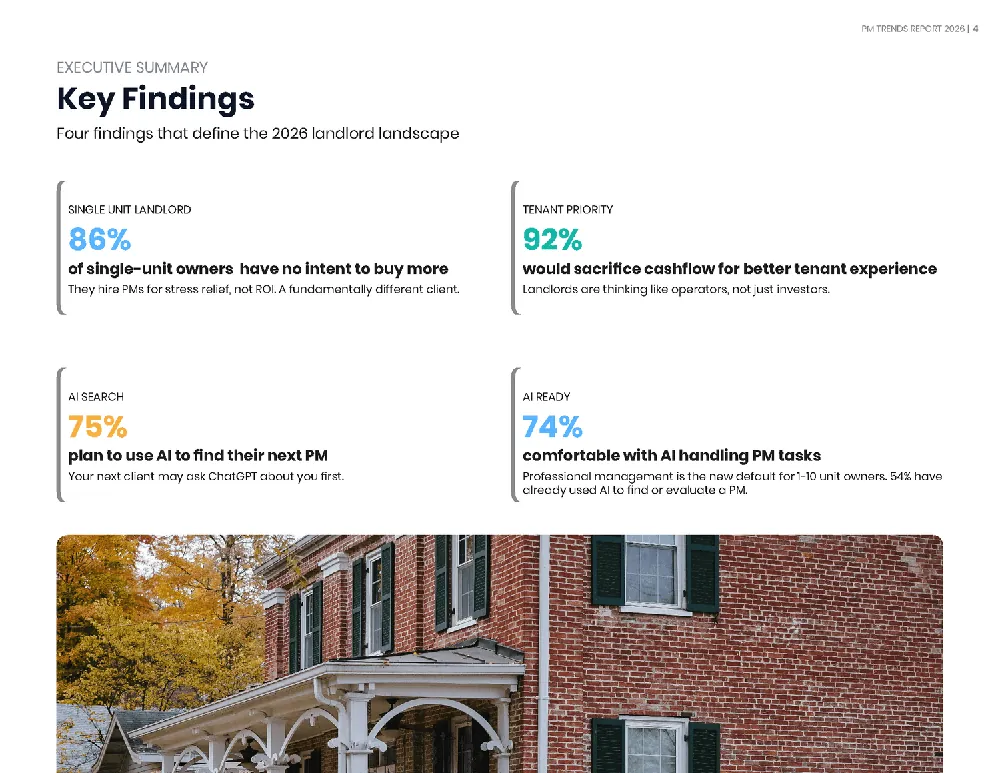
Takeaway #1: 86% of single-unit owners have no intent to buy more
This one genuinely surprised me. "Land and expand" is constantly pitched as the holy grail of PM growth. Get a one-property owner in the door, help them grow, ride the relationship to 10+ doors.
The data says it's mostly a fantasy. 86% of your single-unit clients aren't going to buy another property.
That changes the marketing pitch. It changes the upsell motion. It changes how you think about the lifetime value of a single-unit client. These owners aren't future portfolio investors. They're stressed-out homeowners-turned-landlords who want their problem to go away
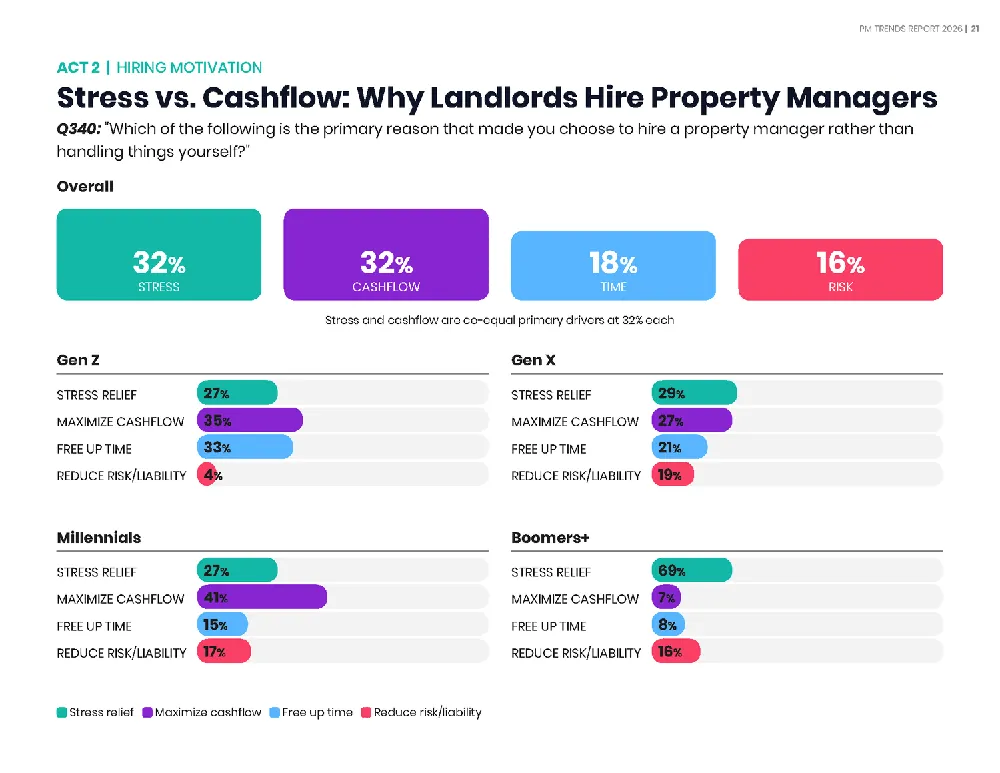
2. Stress relief and cashflow are the only reasons that matter
We asked landlords the primary reason they hired their PM. Two answers dominated, exactly tied at 32% each:
Stress relief — 32%
Maximize cashflow — 32%
"Free up time" (18%) and "reduce risk/liability" (16%) trailed badly.
Risk reduction is a huge part of what we actually do. Our screening process probably reduces the likelihood of a fair housing lawsuit or a costly eviction by a factor of 10 compared to a self-managing landlord. But owners don't sign because of risk. Risk is invisible to them until something blows up.
If you're writing marketing copy, sales scripts, or BDM talk tracks: lead with stress and cashflow. Stop trying to scare people about risk. The data is clear they're not buying that pitch.
3. The Owner Benefit Package is the biggest revenue opportunity in our industry
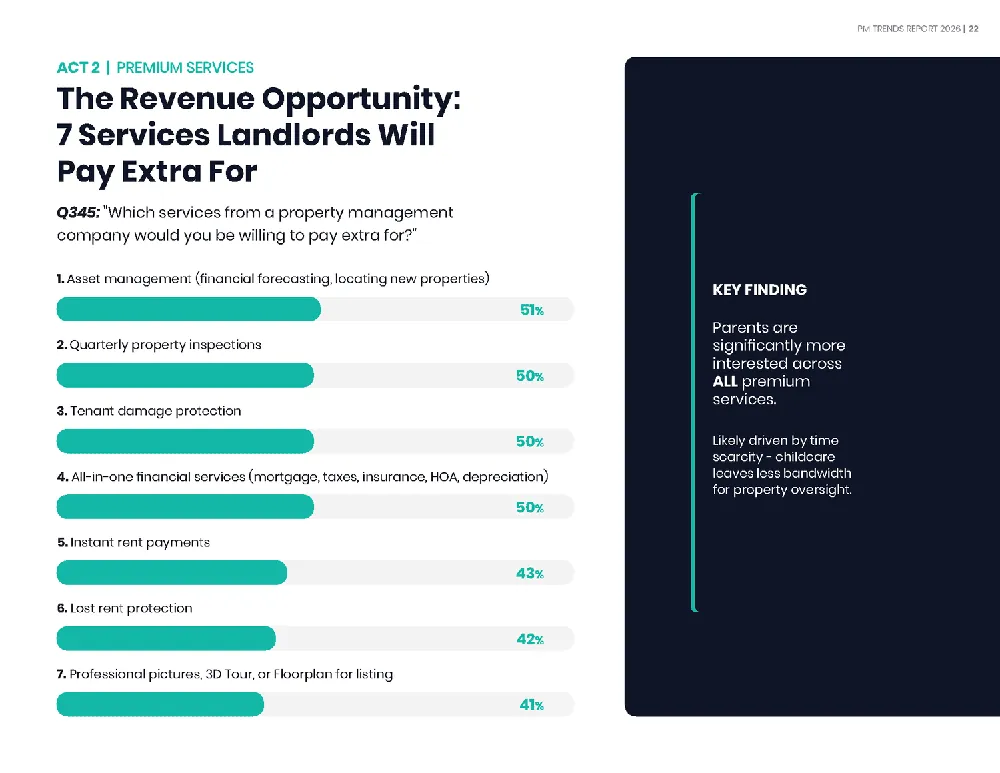
We asked owners what services they'd be willing to pay extra for. Look at these results:
Asset management (forecasting, finding new properties) — 51%
Quarterly property inspections — 50%
Tenant damage protection — 50%
All-in-one financial services (mortgage, taxes, insurance, HOA, depreciation) — 50%
Instant rent payments — 43%
Lost rent protection — 42%
Professional photos / 3D tour / floorplan — 41%
Roughly half of all landlords would pay extra for each of these. That's not a niche. That's a market.
For years our industry has built incredible Resident Benefit Packages. RBPs work. They've also become the target of new legislation and possibly litigation. Meanwhile, we have done almost nothing on the Owner Benefit Package side, even though our easiest customer to sell to is one we already have.
Pick three or four of these. Bundle them. Sell it as an optional upsell at PMA signing and at every annual renewal. If you put this in front of every owner once a year, a double-digit percentage will say yes.
(Or do what Todd O does and just make it mandatory.)
4. After-hours access expectations are wild
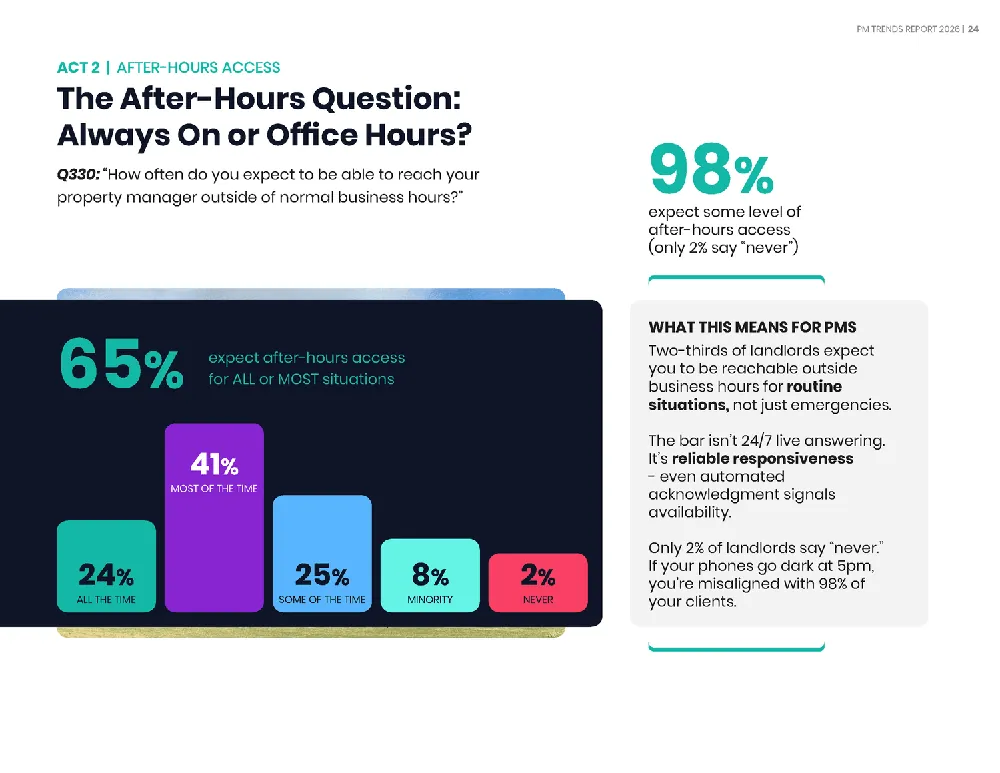
24% of owners (a full quarter) said they expect to be able to reach their property manager all the time outside of normal business hours.
Stack that with "most of the time" (41%) and "some of the time" (25%) and you get to 90% expecting some level of after-hours access.
Then we asked how fast they expect a reply during normal business hours. Across every channel, 30 minutes is the new standard:
70% expect a phone callback within 30 minutes
66% expect a text reply within 30 minutes
47% expect an email reply within 30 minutes
If your shop goes dark at 5 p.m. and replies the next business day, you're misaligned with about 98% of your owner base.
I don't have a clean prescription for this one yet. We're still wrestling with what this means for our operations at RL. But I wanted to get the data into the hands of every PM out there because expectations have moved, and most of us are still operating on the old assumption that owners are fine waiting until tomorrow.
(This is where agentic AI voice tech is starting to look genuinely useful.)
5. 75% of landlords will use AI to find their next property manager
Of course, none of this matters if owners can't find you in the first place. And the way they're finding PMs is changing faster than anything else in this report.
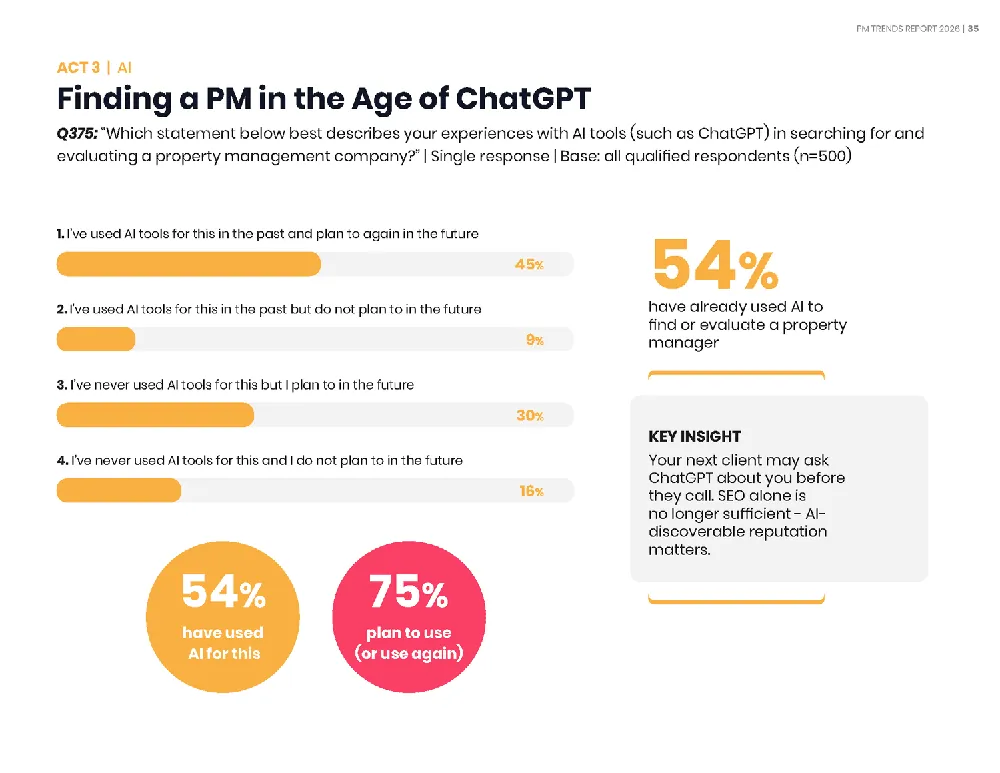
54% of respondents have already used AI tools (ChatGPT, Claude, Perplexity, Gemini) to find or evaluate a property manager. 75% plan to use AI for this in the future.
I have been losing my mind over this stat since I first saw it.
Everything we've spent the last 15 years on as an industry (Google Business Profile, SEO, paid ads, review aggregation) is about to get filtered through an AI layer. Instead of getting one of the top 10 Google results, owners are going to get the top 2 or 3 AI recommendations.
The PMs in each local market who figure out how to rank in AI search results first are going to take massive share of new business. Everyone else is going to watch their inquiry pipeline quietly dry up.
Nobody knows exactly how this is going to shake out. The models change every week. There's already a lot of snake oil being sold in the "rank in AI search" space, similar to the early days of SEO. But here's the floor of what we do know: the more information you publish about your business (services, pricing, neighborhoods, team, philosophy) the more dimensions you have to be recommended on. Right now, disclosure beats restraint. Don't hold your cards close. Put everything out there.
6. Vanessa Anderson (ShowMojo): “There's a 2-week gap between what owners think vacancy looks like and what it actually is.”
AI is changing how owners find us. But what keeps them once they're hired comes down to whether they trust what we're telling them about reality — and three of our data partners came armed with numbers that say a lot of owners don't.
Start with vacancy. ShowMojo's platform data covers 1.3 million leased units across all 50 states. Vanessa came on the webinar to share something that hit me hard.
Owners report their typical vacancy at 3 weeks. They reported the same number in 2024. They've reported the same number every year we've asked.
Actual median days on market in ShowMojo's data?
2021: 2.9 weeks
2024: 4.9 weeks
2025: 5.1 weeks
Reality nearly doubled. Owner expectations didn't move an inch.
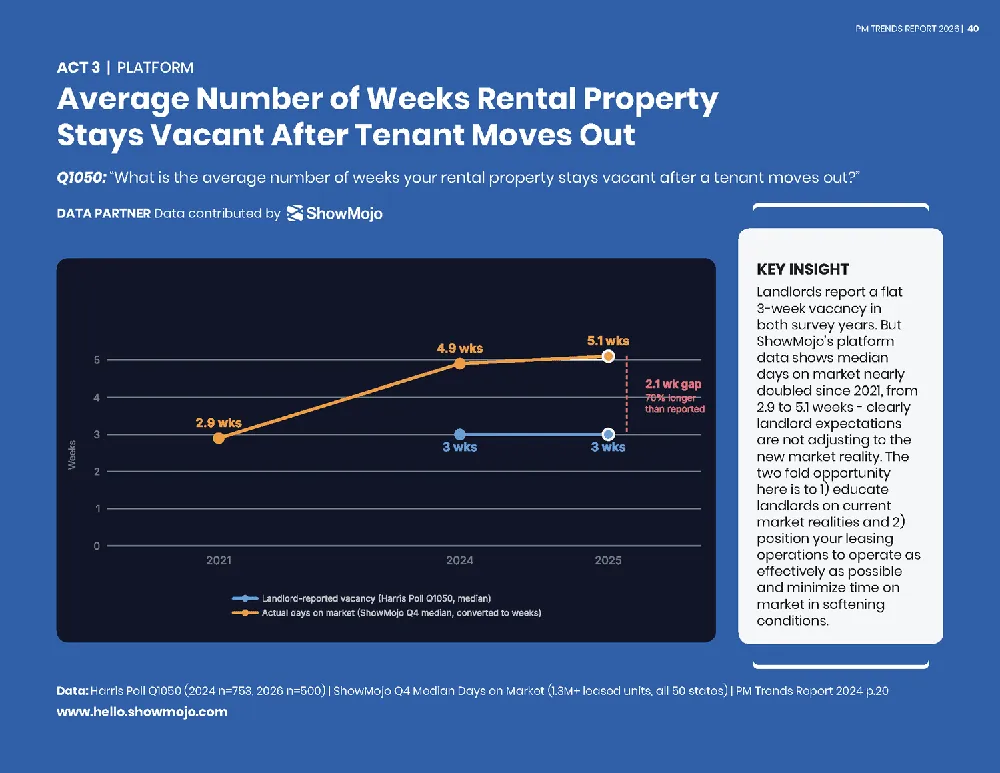
That gap is where owner trust goes to die. They're sitting at home thinking you're dragging your feet, and you're actually outperforming a brutal market. Most owners have no idea what days-on-market looks like in 2026.
Vanessa also showed that ShowMojo customers grew their inquiry-to-showing conversion from 31% to 52% over the same period. Lead volume dropped 55% since 2018; conversion went up 68%. Operators who automated their leasing funnel kept winning even as the market got harder.
The takeaway: if you're not proactively educating your owners on current days-on-market in your specific market, nobody is. ShowMojo is publishing the data, but they can't have the conversation with your owner. That's your job, and it's a real service — not self-serving, just true.
7. Ray Hespen (Property Meld): “Owners think repair costs are up 15%. They're up 42%.”
Property Meld now has 8.6+ million work orders in their dataset. Ray walked us through what's actually happening to maintenance costs versus what owners think is happening.
BLS data — repair labor: +42% since 2019
BLS data — parts and equipment: +30%
General inflation: +26%
Owners estimated maintenance costs were up just 15%
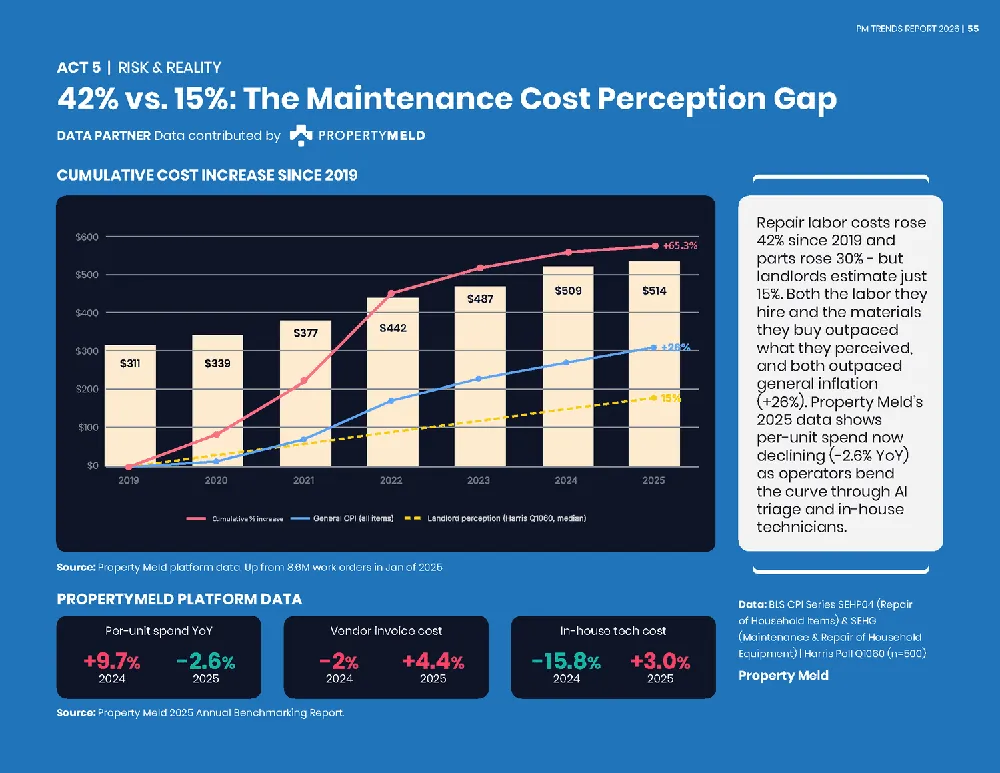
Cost reality has roughly tripled what owners perceive. Which means every repair invoice now arrives looking inflated relative to their internal expectation, even when the bill is dead in line with the market.
This is a trust crisis hiding inside an invoice. Ray's advice: anchor against something objective. Bring data. Show what the market says a faucet replacement actually costs. Don't be the bad-guy car salesman. Be the Kelley Blue Book.
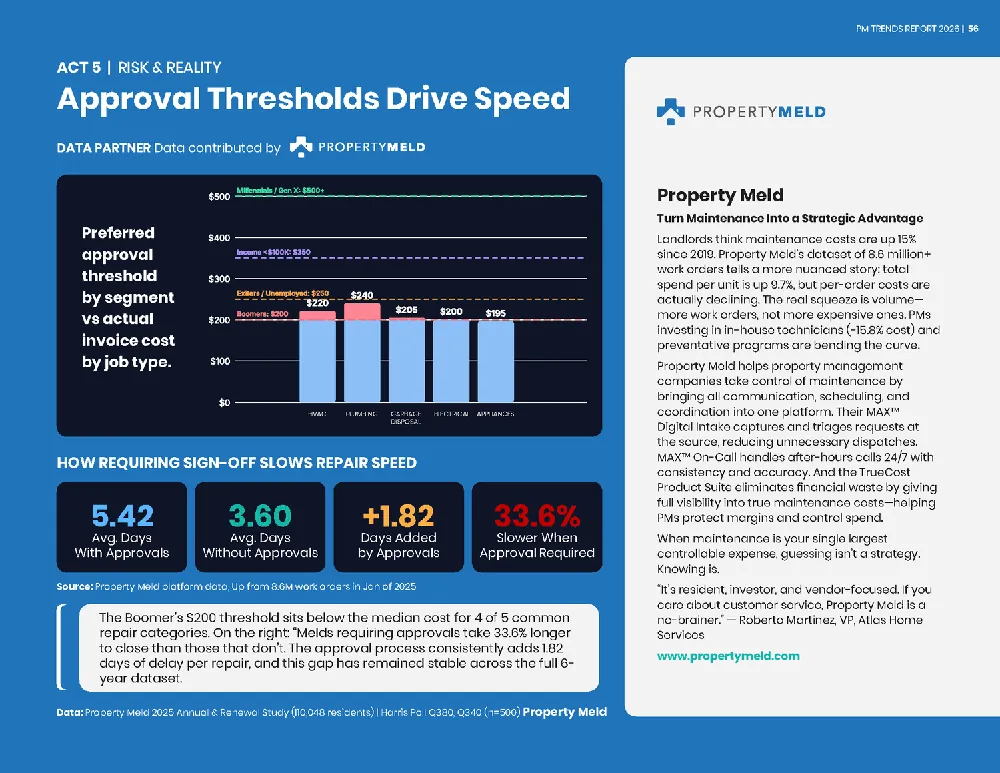
There's a second finding from Ray's data that I want to flag. Owners with low approval thresholds — $200 is typical for Boomers — are slowing down their own repairs and hurting their own returns. Property Meld's data shows any work order requiring approval takes 33.6% longer to close — about 1.82 extra days. In a market where maintenance experience is now directly correlated with lease renewal rates, those 1.82 days are a tax the owner is paying themselves.
The lower the approval threshold, the more friction on every repair, the worse the resident experience, the lower the renewal rate, the higher the owner churn. The "control" the owner thinks they're keeping is actively costing them money.
8. Brad Johnson (ProfitCoach): “Landlords accept more fees than property managers actually charge.”
Owners aren't the only ones operating on outdated assumptions. PMs are too — and Brad Johnson at ProfitCoach brought the numbers.
Brad runs ProfitCoach and works directly with hundreds of PM companies on their financials. He pulled their pricing data and stacked it against our survey results. The result is the most actionable chart in the entire report.
What landlords accept vs. what PMs actually charge:
Late Fees — 83% landlord acceptance, 89.6% PM adoption
Application Fee — 81% accept, 91.5% adoption
Pet Fee — 79% accept, 55.8% adoption (gap of +23 points)
Tenant Benefit Package — 76% accept, 63.2% adoption (gap of +13 points)
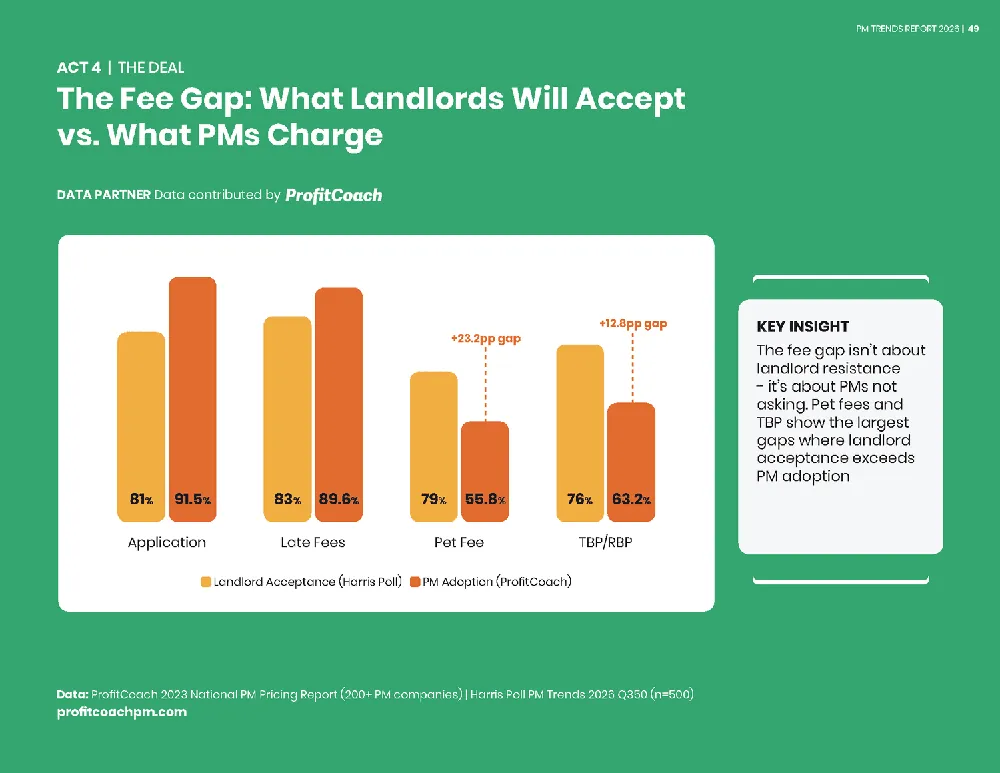
There are landlords actively willing to pay you for pet fees and TBPs who have never been asked. The gap isn't owner resistance — it's PMs not pricing the product.
Brad's bigger point: most PM companies are operating below the revenue-per-unit number they need to be actually profitable. They don't raise fees because they're afraid of churn. The data says the churn fear is mostly a story we're telling ourselves.
Pricing is the single most leveraged thing that impacts revenue in our business. It's also the thing we touch the least.
9. 90% of owners would accept a rent discount in exchange for guaranteed on-time rent
Pricing is one lever. Product is another. And the 2026 data points to one product opportunity that's hard to ignore.
We asked: what's the maximum discount in monthly rent you'd accept from your tenants in exchange for a guarantee of rent paid on time?
90% would take some kind of discount. The median acceptable discount: 10%. Repositioners — your unicorn clients — would accept an 18% discount and 99% of them would take the deal.
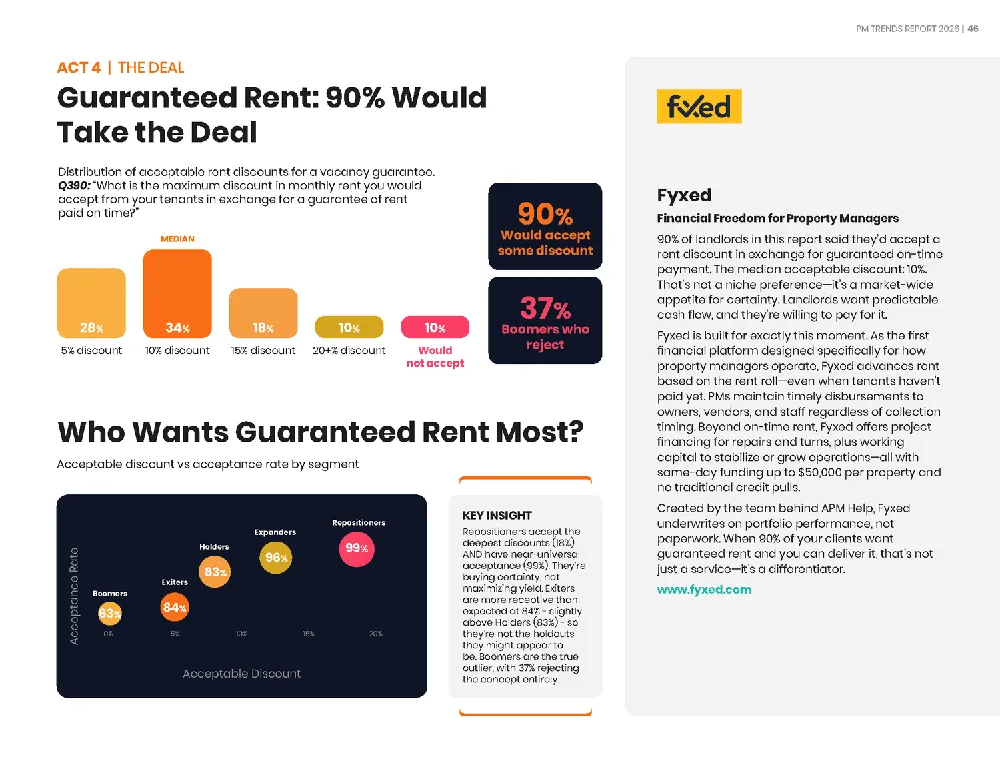
There's already at least one vendor offering this as a product, and I expect more to spring up before the end of the year. If you can build or partner your way into a real rent guarantee program, you've got a retention moat that's hard to copy. 90% of your owners would take that deal tomorrow.
10. Boomers are the outlier on basically everything
If there's one finding from this report I want every PM operator to internalize: Boomers are not your future customer base.
PM usage: 29% (vs 73% Millennials)
Software adoption: 25% (vs 81% Millennials)
AI comfort: dramatically lower across every PM task
Rent guarantee acceptance: 63% (vs 99% Repositioners)
68% reject offshore staffing outright (vs 8% Millennials)
37% say they would never hire a property manager
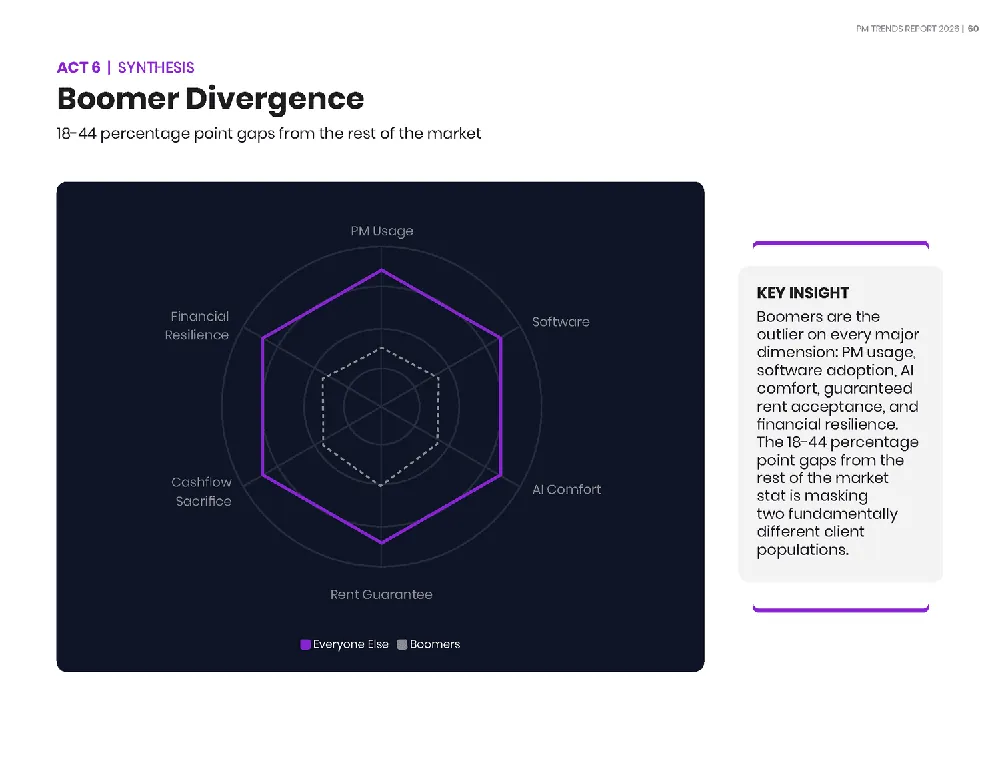
Boomers are aging out. Millennials are 1.7x overrepresented vs the general adult population among landlords, and they're the unicorn client.
The Millennial Repositioner (actively buying and selling, comfortable with software, comfortable with AI, willing to sacrifice cashflow for a better tenant experience) uses a PM 93% of the time and accepts rent guarantees at 97%.
Build your product for that profile. Boomers will phase out of your client base whether you like it or not. Millennials are the future, and they expect a fundamentally different version of property management than the one we've been selling for 30 years.
Grab the full report
We didn't email-gate it. Just go to pmtrends.com, download it, share it. Print copies for your next team meeting. Hand it to your investors. Mail it to your competitors (they'll find out anyway).
A few (very) honorable mentions
The full report is 75 pages and there's a lot more in there. A few highlights that didn't make the top 10:
Demanding clients are your best clients. Owners who expect after-hours access most or all of the time rate their PMs at +52 NPS vs +23 for "easy" clients. Counterintuitive, but consistent across the data. Stop trying to screen out the demanding ones. Charge them more.
The shrinking pie, growing slice. The U.S. has lost 1.5 million single-family rentals since 2016 (sold to owner-occupants). At the same time, professional management adoption has roughly doubled, from ~30% in the 2017 Iceberg Report to 62% today. Total market is shrinking. Our slice is growing fast.
Three independent sources (Zillow, Redfin, Realtor.com) confirm that homes are being pulled off the for-sale market and converted to rentals at near-record rates. These accidental landlords are coming and they need a PM more than anyone.
Income predicts churn better than satisfaction. Owners earning under $100K will sell over a single $15K repair (41% of them). $200K+ owners hold through. Screen for financial resilience during onboarding, not just portfolio size.
Closing
Jordan and I are going to keep publishing this every year, keep chopping up the data, and keep putting it in front of operators who can actually use it.
Massive thank you to our title sponsors Rentvine and Column, our data partners Property Meld, ShowMojo, and ProfitCoach, and the rest of the sponsors (pg. 67-74) who made this possible. Original research like this isn't cheap. It exists because they believed it should.
If you want to talk through what any of this means for your business with operators wrestling with the same questions, the best place for that conversation is inside Crane.
And if you only do one thing after reading this — go download the report. It's free. There's no email gate. Just go grab it.
— Peter
P.S. here’s the webinar: